It's crazy to think that by the end of this month, my 74-page frankenset series will likely draw to a close. I seem to be averaging one of these pages every week or so, so it stands to reason that the series will officially be wrapped up towards the end of the month.
Today's page is #71 in the series, featuring cards #631-639 that span 5 consecutive decades (the 1970s-2010s). Let's get started.
#631 1983 Fleer Pride of Venezuela
This combo card may be the first of the page, but I'm already declaring it my favorite just like the Big Red Machine from the previous frankenset post. Both Trillo and Concepcion were entertaining players to watch in the late 70s and early 80s, especially when the former was a member of the Chicago Cubs.
Plus, there's something harmonious about the 2 red uniforms and the basic silver-bordered '83 Fleer design. There's just, to put it simply, a lot to like about this card.
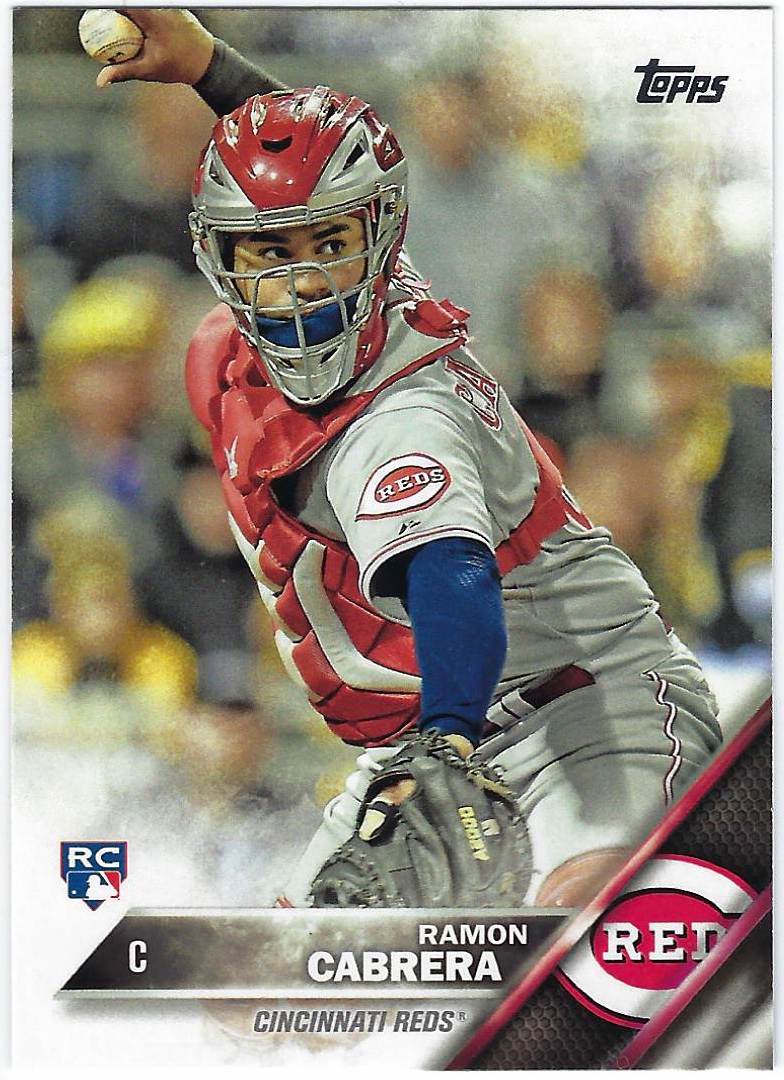
#632 2016 Topps Ramon Cabrera
I could get into my issues regarding the 2016 Topps set yet again on the blog, but I'll refrain from that and instead focus on the fact that Topps did a nice job with this card.
Look, the card isn't groundbreaking or extraordinary, but I always love the way a catcher's action card looks as he prepares to throw the ball in an attempt to prevent a runner from stealing. If nothing else, the mediocre to put it kindly nature of the 2016 Flagship set didn't stain this card.
#633 2006 Topps Josh Barfield
I don't know if Topps was attempting a combination of modern and retro with the 2006 Topps design. All I know is that the color pairing did not work out very well as far as the San Diego Padres' cards are concerned.
Orange and brown may have looked great together back in the 1970s when Topps could make virtually any color combination work, but the same can't be said when a silver foil design is added to the mix.
#634 2013 Topps Drew Smyly
Over the last few years of Topps Flagship, particularly 2019, I've noticed a resurgence in retro uniforms making appearances on base cards. The inclusion of these throwback jerseys is something that I'm quite happy about, for they weren't always as common as they are now.
To be quite honest, I don't recognize the jersey that Drew Smyly is wearing in the card above.
#635 1978 Topps Joe Rudi
Joe Rudi remains one of my favorite members of the Swingin' Oakland A's teams from the early/mid-1970s, but by '78, Rudi was no longer playing in the Bay Area. He joined the California Angels after the 1976 season and remained there until '81 when he played for the Boston Red Sox for a year.
After a down season in Boston, Rudi spent 1982, the final year of his career, back with the Oakland A's. Interestingly enough, he hit a home run in his final MLB at-bat.
#636 1992 The Sporting News Conlon Collection
Don't get me wrong, I'm incredibly fond of the breathtaking 1992 Sporting News Conlon Collection set. However, I don't want the cards to be featured too frequently and, thus, become repetitive.
With that being said, the photography, no matter how many cards I look at, never fails to impress me. The fact that hundreds of Conlon's photographs were compiled into one cohesive set is nothing short of extraordinary.
#637 2010 Topps Prestigious Pinstripe Power
The 2010 Topps set, even as far as this decade's Flagship products are concerned, does very little to impress me. The overly-large font used for team names is about the only thing that sets this design apart from others, and that's not necessarily a positive attribute.
It seems to me that this set is forgotten amongst all the others that have been produced this decade, and in my eyes, Topps should be thankful for that.
#638 2015 Topps Jimmy Rollins
Seriously, all you have to do is look at 2010 Topps next to a card from the 2015 Flagship set to understand what I'm saying. Topps has produced 20 base sets this century and as far as I'm concerned, none of them have come close to rivaling the colorful and vibrant 2015 design.
#639 1987 Topps Gerald Perry
Last up, a card from 1987 Topps, a set that we haven't seen featured on one of the frankenset pages in a little bit. As a result, I have slightly more positive feelings towards the wood-bordered set, because I haven't seen any of its cards in quite some time.
A die-hard Red Sox fan collecting cards of Craig Kimbrel, the Red Sox, other players, and a whole lot more.
Friday, November 15, 2019
Wednesday, November 13, 2019
Top 5 Cards; Jacob deGrom
A couple of hours, New York Mets ace Jacob deGrom captured the 2019 NL Cy Young award, giving him back-to-back award wins for the 2018 and 2019 seasons.
Last year, when the right-hander posted a historic 1.70 ERA and struck out 269 batters, deGrom was a lock for his first-ever Cy Young award. Though he was, once again, fabulous in 2019 (2.43 ERA with 255 K's) he wasn't quite as dominant as the year before.
He also faced some tough competition from division rival Max Scherzer and Dodgers pitcher Hyun-Jin Ryu, but the results, more or less, remained the same. Once again, deGrom received 29/30 first-place votes, catapulting him to his 2nd straight award win.
I'll be intrigued to see what rookie manager Carlos Beltran does with a Mets pitching staff in 2020 that'll consist of deGrom, Noah Syndergaard, Steven Matz, and Marcus Stroman.
This rotation, barring any injuries or declines in performance, should be among the best in baseball, and they'll have an excellent ace at the helm.
I haven't been player collecting Jacob deGrom for all that long, but I've amassed 61 total cards of the 31-year old. This total puts him at #100 on my list of player collections, organized from largest to smallest.
Though the countdown may not feature as wide of a variety of cards as some of the other players that I collect, I'm quite pleased with how the top 5 turned out.
#5 2018 Topps Chrome Negative Refractor
When deciding which cards should make the top 5 and what the order should be, I try not to include a card solely because I like the set design/parallel. I did, however, feel obligated to make a small exception for deGrom's negative refractor from 2018 Topps Chrome.
Unlike paper parallels or even, say, other refractors from Topps Chrome, the negative encompasses the entire card, so one's feelings towards this type of refractor will dictate their thoughts on the card itself.
Because I love the look of negative refractors, this card was a no-brainer to make the top 5.
#4 2016 Panini Donruss 1982 Design
If this 1982 Donruss insert from the 2016 set had the MLB license, it could've made the top 2 on this countdown. The fact is, however, that deGrom's helmet looks incomplete without the New York Mets logo as does his home uniform.
That's not to take away from how creative Panini was with this insert card by showing a picture of deGrom at the plate rather than on the mound. He's actually one of the better hitting pitchers in the NL after launching 2 home runs in 2019.
The lack of logos may have caused this card to miss out on making it higher up on the list, but I still appreciate the little nuances that make this insert so unique.
#3 2017 Topps High Tek Blackout Parallel Pattern 1
One of the benefits of player collecting 250+ guys, both active and retired, is that it exposes me to a plethora of products that I'd otherwise be widely unfamiliar with. I can think of no better example than Topps High Tek, a set I'll likely never buy a box of in my life.
The veteran base cards, however, routinely end up in the dime bins, even serial numbered cards and parallels, like the blackout one above. I particularly like the sleek design, for the back of the card is a light shade of grey and creates a contrast from the front.
#2 2019 Topps Inception Green Parallel
I don't know if I paid a dime for the green parallel above like I did for the blackout card from High Tek, but I'm certain that I haven't opened a box of Topps Inception in my life. As a result, we have yet another instance of my collecting a surplus of players and, thus, being exposed to a ton of different products.
A lot is going on with this card, to say the least. There's the green parallel along with the purple/blue background, making for an extremely modern design.
From the handful of Topps Inception singles that I have purchased, I love the base design and wish they'd release something like this set in a more affordable format.
#1 2017 Topps Bunt Infinite
It's not as flashy as any of the parallels on this list nor as creative as the Panini Donruss insert, but the simplicity and, honestly, the overall awesome design of this 2017 Topps Bunt insert helped catapult this card to the #1 spot on the countdown.
I love the contrast between the slightly-faded picture of deGrom and the outside of Citi Field, and while that's pretty much all this card has to offer, there's something to be said about its simplicity.
Some days, I'll go for a negative refractor or a blackout parallel to capture the #1 spot on a top 5 cards list. Other times, however, I prefer something simple yet stunning, and that's exactly what the Topps Bunt Infinite card does.
Monday, November 11, 2019
$5 Cards; Card Show Recap #25 Part 2
In what will likely be my final Baseball card haul until Black Friday (I'll either buy cards on COMC or head to the Mansfield show), I decided to vary in what I purchased so that I ended up with a wide range of different cards.
After initially picking up a stack of 90s oddballs and 2010s Red Sox cards, I wandered through the show floor with nothing particular in mind that I was searching for. As is often the case, I didn't have to look that long before I came across something of interest, a 2-row box of cards marked at $5 each.
Once I'd spent several minutes searching through the stacks of $5 cards, I knew where I'd be spending the rest of my time and money at the show. The bin didn't consist solely of Baseball cards, but there were, nonetheless, gems scattered across the 2 different rows.
Whereas I sometimes have to narrow down what I purchase to fit a certain budget, there were exactly 8 cards that caught my eye. Thankfully, I didn't have to swap any of them out and was able to secure every one of them.
The first one I chose was a 1960 Topps card of Brooks Robinson, one of my favorite Flagship designs of all-time. Robinson is one of my gold tier player collections, meaning I have over 100 cards of the 15-time All-Star. This new pickup, however, is now the oldest card that I own of Robinson.
While each of the other 7 cards in this lot is a base card, the Joe Morgan card above is actually the only relic in the group, a bat relic numbered out of 99 from 2016 Panini Pantheon.
I purchased this card with a full understanding of the fact that relics aren't what they used to be because I believed that a $4 HOF relic was too good of a deal to pass up. The concept, however, is where I'm a tad confused.
This bat relic is from a subset called Gallant Gloves, so wouldn't it make much more sense for the memorabilia to be from one of Morgan's game-used gloves? Or if Panini can't get enough gloves to produce these cards, name the card something else.
Still, I purchase inexpensive Hall of Fame relics whenever I get the opportunity, and the Joe Morgan bat relic, despite the contradictory name, fits the bill.
2011 Topps Update is obviously known for the iconic Mike Trout rookie card, but the set is also home to first-year players such as Jose Altuve, Paul Goldschmidt, and Anthony Rizzo.
Though I'll likely never come across a Mike Trout rookie card for a reasonable price, I can at least say that I have some of the other top rookies' cards from the highly sought after set, those players being Jose Altuve and, now, Anthony Rizzo.
Rizzo has been one of my favorite players in the game over the last several years. His consistency, both offensively and defensively, is truly remarkable, and I can only imagine what today's Red Sox team would be like if he was still a part of their organization.
His rookie card might not be the most valuable of the bunch, but I'm, nonetheless, thrilled at the price I paid to add this card to my Rizzo player collection.
The $5 price point was to steep for me to take a risk and purchase a card that I may already have in my collection, so I decided to check my player collection spreadsheets before adding this 1974 Topps Nolan Ryan card to the stack that I was amassing. Sure enough, I didn't have the card, but I do now.
This card, along with a few other .50 cent cards from yesterday's show, is getting me even closer to the 500-card mark that I'd like for the Ryan PC to reach by the end of the year.
The current total, with the additions from the card show, is around 485, and I'd like to get to 500 without explicitly buying 15 Nolan Ryan cards on COMC.
Because league leaders cards, particularly those from the 1960s and 2010s, often feature multiple players whom I collect, I need to have some way to decide which player collection the card will go towards.
I have a rule that the card will go to the highest-ranking player who also happens to be one of my player collections. I don't have a PC for Sandy Koufax (though I really should), so this 1967 Topps card, noting the '66 NL wins leaders, will go to Juan Marichal.
There's something about rookie cup cards, particularly those with the tall trophies from the 1960s, that never fails to captivate my attention. Plus, vintage rookie cup cards are a nice, inexpensive alternative to rookie cards, yet they're a tad more interesting than just a simple base card.
The condition of this 1968 Topps Tom Seaver card might not be too stellar, but the All-Star rookie trophy along with the extremely fair price helps me look past the crease down the middle of the card. Not to mention, the '68 Topps base set design happens to be one of my favorites.
The final 2 cards from the 8-card purchase are set needs, the first of which I have been trying to track down for quite some time now. I'm talking about Hank Aaron's final Topps Flagship card, an iconic shot of the true home run king as a member of the Milwaukee Brewers.
As is typical for the 1976 Topps set, the card features a daring color combination (pink and purple) that Topps was, somehow, able to pull off. Before Sunday's show, I hadn't seen a fairly-priced '76 Aaron card, so it was huge for me to check such a major card off the list.
Now, as far as I know, there isn't another big card like Aaron's standing in my way of completing this set.
The most critical pick up from yesterday's show, undoubtedly, would have to be the 1961 Topps Willie McCovey card above, another major set need, of mine that I can now cross off the want list.
Unlike '76 and '79 Topps, there are several expensive veteran and 1 rookie (Juan Marichal) cards standing in my way of completing the 1961 Topps set. While I was able to make progress at The National, there's still a long way for me to go if I want to complete this 589-card set.
Adding this McCovey card to my collection is huge because it's another Hall of Famer, not to mention a high number, that I don't have to worry about.
But with Mickey Mantle, Roger Maris, and most of the All-Star cards still on my radar, I'll have to hope that another bargain like this comes my way.
Sunday, November 10, 2019
Unfamiliar Territory; Card Show Recap #25
I take pride in having a reasonable understanding of Baseball and cards, particularly the 1960s-70s and the 2010s. It helps when I want to include bits of information on my frankenset page posts or when I'm updating my online player collection inventories following a trip to the card show.
Being able to write a few sentences about Dave Parker off the top of my head or identify some crazy Panini Prizm parallel helps me out big time, but really, the more cards/information I come across, the better equipped I am for when the next stack of dime cards needs to be categorized.
That being said, there's always been one period in Baseball history that's challenged my ability to identify cards and list facts about players. I'm referring to an era chock full of various brands, products, and parallels as well as high print runs and, to make things more confusing, dates printed on the back of the cards that don't match the year the set was released (I'm looking at you, Upper Deck).
The mid-1990s through the end of the decade (~1995-1999) perplexes me to this day. There's just so much inventory that I haven't yet familiarized myself with like I have for virtually all other decades in Baseball card history.
Alas, when updating my player collection inventories, I have to search for most mid-90s cards on COMC to ensure that I'm adding the correct one to the spreadsheet.
I suppose, nonetheless, that continuously buying and adding cards from '95-'99 to my collection will only help me gain more knowledge about this period in Baseball history. This plan, unintentionally so, went into effect when I visited my local Baseball card show earlier today.
Before I get to the glorious cards from the 90s, there was a small portion of pickups from today's post of cards that didn't hail from the last century.
As is always the case when I'm at the card show, I kept my eyes peeled for Red Sox singles so that I can continue adding to and building up my coalition of Red Sox cards, meaning both my player collections and the actual PC.
The 4 cards above, come to think of it, are all from 2019, and most of them will be going to their respective player collections. The only exception is the Wade Boggs card which will go towards my 2019 Panini Prizm project.
In addition to new Red Sox cards and 2019 Panini Prizm project additions, I'm always on the lookout for new Craig Kimbrel cards to add to the closest thing I have to a "super collection."
If someone were to ask me for my top 3 focuses as a collector, I'd list the 3 things above, though I'd have to rank my individual player collections above all.
Anyways, I came across a new Kimbrel card while searching through a bin of cards priced 3/$1. One of the easiest decisions I made all day, I added the card to my stack and went on with my time at the show.
I suppose you could include the first couple years of the 2000s (2000-2002) alongside the mid-to-late 1990s in terms of periods in Baseball history that I'm not overly familiar with. Honestly. with all the different brands, sets, inserts, and parallels out there, can you really blame me?
I will, however, stand by my thoughts that the 2000s, leading up to the end of Donruss and Fleer's respective runs as Baseball card manufacturers, was one of the golden ages of card collecting. Even if Panini gets the MLB license, I doubt we'll see as wide of a selection of sets as we did in the early 2000s.
It was that period, for better or for worse, that delivered some picturesque set designs and creative inserts, just like the 2 cards above.
Moreover, stars who debuted in the early 1990s and lasted through the mid-2000s are the recipients of some of the most cards produced of any single player, primarily because they played at a time where there were numerous brands, each of which was striving to produce the best possible cards.
What I got, as a result, was an extensive range of Ivan Rodriguez cards, for example. This sheer variety is what allows for so many of my player collections to reach gold and even platinum tier status. The wide selection and availability of some players' cards are simply unparalleled.
At the end of the day, Baseball cards from this era, more so than most others except for the 2010s, will be viewed with mixed opinions depending on what each collector likes and looks for in a card.
Those who love inserts and parallels as much as I do will be fond of the mid-1990s while those who prefer traditional cards might not be so inclined to pick out either of the 2 Topps Tek cards above.
At the end of the day, these cards have their ups and downs just like all others, but something intrigues me about the unfamiliarity that makes me want to come back for more.
I know that I haven't discovered everything that this period has to offer, and that's both exciting and slightly scary at the same time.
Being able to write a few sentences about Dave Parker off the top of my head or identify some crazy Panini Prizm parallel helps me out big time, but really, the more cards/information I come across, the better equipped I am for when the next stack of dime cards needs to be categorized.
That being said, there's always been one period in Baseball history that's challenged my ability to identify cards and list facts about players. I'm referring to an era chock full of various brands, products, and parallels as well as high print runs and, to make things more confusing, dates printed on the back of the cards that don't match the year the set was released (I'm looking at you, Upper Deck).
The mid-1990s through the end of the decade (~1995-1999) perplexes me to this day. There's just so much inventory that I haven't yet familiarized myself with like I have for virtually all other decades in Baseball card history.
Alas, when updating my player collection inventories, I have to search for most mid-90s cards on COMC to ensure that I'm adding the correct one to the spreadsheet.
I suppose, nonetheless, that continuously buying and adding cards from '95-'99 to my collection will only help me gain more knowledge about this period in Baseball history. This plan, unintentionally so, went into effect when I visited my local Baseball card show earlier today.
As is always the case when I'm at the card show, I kept my eyes peeled for Red Sox singles so that I can continue adding to and building up my coalition of Red Sox cards, meaning both my player collections and the actual PC.
The 4 cards above, come to think of it, are all from 2019, and most of them will be going to their respective player collections. The only exception is the Wade Boggs card which will go towards my 2019 Panini Prizm project.
In addition to new Red Sox cards and 2019 Panini Prizm project additions, I'm always on the lookout for new Craig Kimbrel cards to add to the closest thing I have to a "super collection."
If someone were to ask me for my top 3 focuses as a collector, I'd list the 3 things above, though I'd have to rank my individual player collections above all.
Anyways, I came across a new Kimbrel card while searching through a bin of cards priced 3/$1. One of the easiest decisions I made all day, I added the card to my stack and went on with my time at the show.
I suppose you could include the first couple years of the 2000s (2000-2002) alongside the mid-to-late 1990s in terms of periods in Baseball history that I'm not overly familiar with. Honestly. with all the different brands, sets, inserts, and parallels out there, can you really blame me?
I will, however, stand by my thoughts that the 2000s, leading up to the end of Donruss and Fleer's respective runs as Baseball card manufacturers, was one of the golden ages of card collecting. Even if Panini gets the MLB license, I doubt we'll see as wide of a selection of sets as we did in the early 2000s.
It was that period, for better or for worse, that delivered some picturesque set designs and creative inserts, just like the 2 cards above.
Moreover, stars who debuted in the early 1990s and lasted through the mid-2000s are the recipients of some of the most cards produced of any single player, primarily because they played at a time where there were numerous brands, each of which was striving to produce the best possible cards.
What I got, as a result, was an extensive range of Ivan Rodriguez cards, for example. This sheer variety is what allows for so many of my player collections to reach gold and even platinum tier status. The wide selection and availability of some players' cards are simply unparalleled.
At the end of the day, Baseball cards from this era, more so than most others except for the 2010s, will be viewed with mixed opinions depending on what each collector likes and looks for in a card.
Those who love inserts and parallels as much as I do will be fond of the mid-1990s while those who prefer traditional cards might not be so inclined to pick out either of the 2 Topps Tek cards above.
At the end of the day, these cards have their ups and downs just like all others, but something intrigues me about the unfamiliarity that makes me want to come back for more.
I know that I haven't discovered everything that this period has to offer, and that's both exciting and slightly scary at the same time.
Subscribe to:
Posts (Atom)