Showing posts with label Kellogg's. Show all posts

Thursday, March 12, 2020

The New Frankenset: Page #6

The last 24 hours have been the craziest in terms of sports events that I can recall. Virtually all events, including the rest of the NBA and NHL seasons as well as the much-anticipated March Madness, have been canceled.

Spring Training is finished and the MLB season will be delayed at least 2 weeks. College sports have also been shut down, but truthfully, the Coronavirus issue goes way beyond the sports world.

I don't want to get too much into the details of the pandemic. After all, this is a Baseball card blog, and my goal is simply to provide interesting content related to the greatest sport in the world.

However, it's imperative that everyone is aware of the symptoms and stays safe during the foreseeable future. Awareness and proper hygiene is the #1 thing that each and every one of us can do to prevent it from spreading even more.

Now that I've addressed the unavoidable, I would like to move onto the 6th page of my new frankenset, the subject of today's blog post. As I mentioned, my goal is to (when I can) write and provide interesting content about various topics within the hobby as well as Baseball as a whole.

Hopefully, this frankenset page, featuring cards #46-54, can do that, and we can all take a 5-minute break from thinking about the Coronavirus.

#46 1974 Kellogg's 3D Super Stars Bert Blyleven
My dream of a Kellogg's 3D card revival seems highly unlikely unless Topps reaches out to form a partnership, but I can't help but want something like that to happen given the caliber of the original cards from the 1970s and 80s.

In my eyes, Hostess and Kellogg's are the top oddballs in the history of the hobby, though I'd give the latter of the 2 the edge if it came down to it. Although a few designs, most notably those with blue borders, blend together in my mind, certain sets, like 1981, stand out to me.

#47 2007 Bowman Heritage Mark Teixeira
If Topps actually wanted last year's Bowman Heritage release to be a success, it should've come out earlier in the year (not at the same time as Bowman's Best, an anticipated and popular product), and they should've included a retail format so the set would appeal to a wider audience.

It's challenging for a lot of collectors, myself included, to get behind purchasing and collecting prospect cards. However, if Bowman used a more interesting format, like Heritage, they'd be able to draw my interest toward the entire field of prospect collecting.

#48 2016 Topps Stadium Club
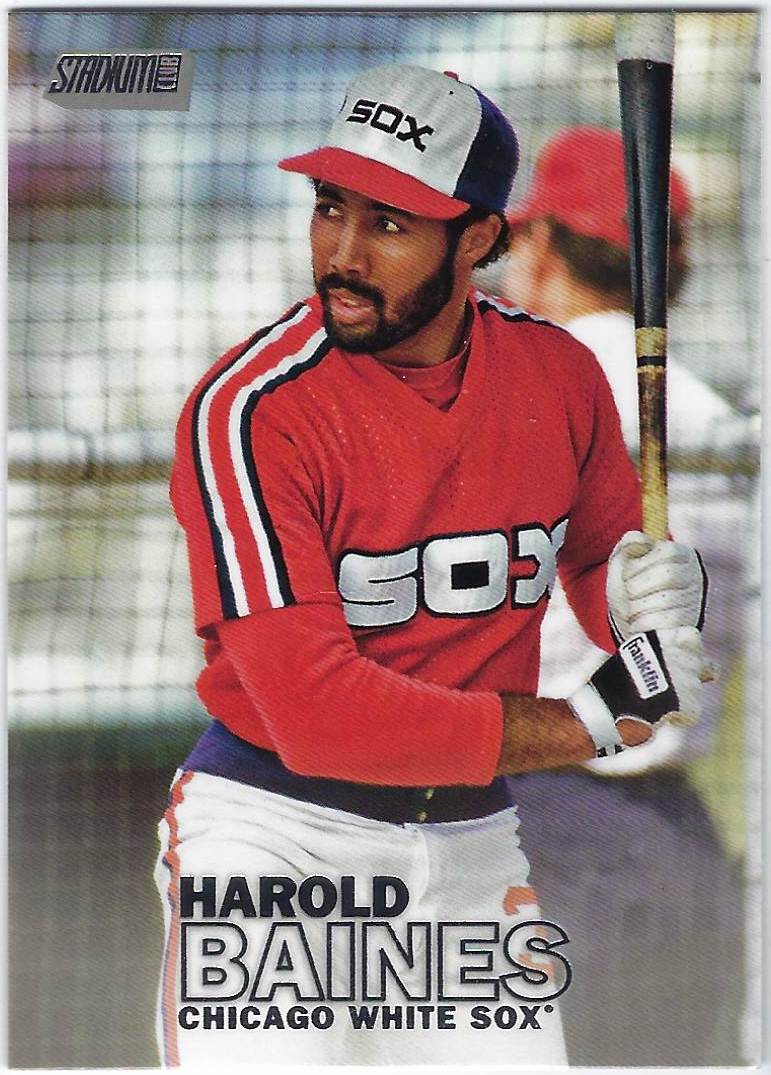
Produced before he was elected to the Baseball Hall of Fame, Harold Baines' 2016 Topps Stadium Club card is one of my favorites from the entire set, and that's a bold statement given the sheer caliber of the '16 product, specifically the checklist and photography.

It's impressive enough when Topps captures shots of current players using all sorts of different angles and so on, but it's the enhanced photos from decades prior that elevate Stadium Club to the top tier of all releases.

#49 2005 Upper Deck ESPN Scott Podsednik
I feel like this collaboration between card producer Upper Deck and TV/news network ESPN had strong potential, but the duo failed to give the cards an identity/concept in addition to the modern design.

I'm not exactly sure how I would design/market these cards so that they were more than just a set with the name ESPN attached to them, but there's definitely a whole lot more that could've been done to enhance the quality.

#50 2003 Fleer Authentix Jorge Julio
Seeing this ticket emulation from Fleer Authentix brings me back to the same idea that I started this post by talking about: the fate of sports, particularly the new MLB season, in the wake of the Coronavirus outbreak.

I'll be watching to see whether MLB pushes the schedule back to get all 162 games played or if they opt to cancel the first several weeks and, thus, have an abbreviated 2020 season.

As far as I know, something like this is unprecedented in its effects on sports, particularly baseball, so there's not necessarily a proper way to handle things.

#51 1984 Donruss Dave Winfield
First came Blyleven, then Baines, and now Dave Winfield: half of the first 6 cards of this page feature members of the Baseball Hall of Fame, and while the final of the 3 doesn't have quite as interesting of a card, it's still nice to have some superstar representation.

I actually appreciate the choice to feature this type of image with the '84 Donruss design, one that allows for photographs to take up most of the card. With that being said, the set itself is rather uninspiring, so the pictures need to blow me away to make up for it.

#52 1966 Topps Power Plus
It doesn't matter if the condition is a little worse for wear or if I don't even collect either of the players featured: I will always have a profound appreciation for combo cards from the 50s, 60s, and 70s Topps sets, as well as the, recreates in today's Topps Heritage.

As fabulous as vintage Topps sets are, the base cards, like any set, can get rather repetitive after a checklist of several hundred. Breaking up the set to avoid becoming boring is essential, and that is exactly the role that combo cards like the one above play.

#53 2016 Panini Donruss Clayton Kershaw
It might just be my personal dislike for the 2016 Panini Donruss set, but I feel like this card stands out like a sore thumb among the rest of this page. Even the Podsednik and Winfield, 2 cards that I'm not exactly crazy about, fit better with the page than Kershaw's from '16 Donruss.

The reason for this, simply put, is licensing. The less than stellar design/photograph is only made worse because of the fact that Panini, to no fault of their own, cannot use the MLB logos.

Thankfully, they've stepped up their game in the years that have followed with products like Leather & Lumber and Prizm. Hopefully, MLB will reward them with the license as soon as Topps' exclusive rights end in a few years.

#54 1963 Topps Rookie Stars
Last up, a good old-fashioned rookie stars card from 1963, a title that seemed to almost doom the career of anyone it was applied to.

Although none of these guys became superstars in the MLB, it's certainly worth noting that Dave Debusschere eventually became a member of the Basketball Hall of Fame.

Tuesday, August 6, 2019

50s Topps, A HOF Rookie, & More Vintage; 2019 National Recap Part #2

Moving right along with my series of recap posts from the 2019 National, I have a haul of vintage pickups for both the teams and the players that I collect ready to go today.

While I mentioned that the cards featured in yesterday's post were a part of my only player collection oriented purchase, I still grabbed other cards for my PCs across my 2 1/2 days at the show. 

However, my Dad and I's mission was to go after cards that I couldn't necessarily find back home. A perfect example of this is the card at the top of this post; Nolan Ryan's 1971 Topps card which my Dad tracked down.

Buying vintage cards was one of our main objectives for this year's show just as it was at the 2018 National in Cleveland. We both understand that cards from the 50s and 60s aren't going to be readily available forever, especially at the bargain prices that we often see them going for.

In addition to filling in cards from the 1961 and 1976 Topps sets throughout our time in Chicago, we made multiple vintage card purchases while at the show that, ultimately, added up into an impressive haul, consisting of cards from the early 1950s, 3Ds from the 70s, and even a HOF rookie.

I'll showcase some of the other 1970 Kellogg's 3D cards that we picked up later in the week, but, for now, I'll start with the 4 players above, all of whom I collect. Another project of my Dad's, he has always been fond of 3D cards, particularly the Kellogg's brand. 

Whether they're for our 3D binders or player collections, Kellogg's cards are often on his radar when we attend larger Baseball card shows. This time, he assembled a group of 70s Kellogg's cards, including one of Joe Morgan from his early seasons with the Houston Astros. The headshot and the sky background easily makes Morgan's card my favorite of the lot.

Though Morgan's card happens to be my favorite, that doesn't discount the fact that my Dad found a new card for our Ron Santo player collection, something that certainly doesn't happen every day. 

Although he's a 9-time All-Star and a 5-time Gold Glove award winner, Santo is one of the most underappreciated and underrepresented players in Baseball history. He wasn't inducted into the Hall of Fame until after he passed away in 2010, and his most recent Baseball card (excluding fancy hits), according to COMC, is an insert card from 2016 Topps.

I urge Topps to feature Santo in sets like Allen & Ginter and Archives to give this Baseball legend the respect he deserves. However, if I can't have my wish, at least I have his awesome '70 Kellogg's card.

As focused as I often am on boosting my 250 player collections, my Dad is quite the opposite. He has no qualms about buying cards of non-PC guys so long as there are some parameters to what he purchases. 

Though I likely wouldn't have chosen these cards myself, I'm pleased that he ended up buying some vintage Red Sox and Cubs cards from the 1950s. As many Cubs and Red Sox cards as I have, my collection is somewhat limited as far as the early and mid-1950s are concerned (i.e. anything before 1957).

In fact, I didn't even have a single Topps card from 1952 or 1953 going into The National this year. Thankfully, I was able to make some progress with the absence of those 2 sets.

Though we never got our hands on a '53 Topps card, we finally landed our first ever 1952 Topps base card, and the player of choice is Red Sox catcher Gus Niarhos. I also added another '52 Bowman Red Sox card to my collection (Vern Stephens) to go with my other one (Clyde Vollmer).

Even though the players on and the condition of these cards aren't the greatest, that's not a significant concern of mine when it comes to cards from as far back as 1952. 

Frankly, I'm just pleased to have these in my collection in the first place, for I would have difficulty tracking these cards down at the shows I attend.

Now that I have all the photos scanned for this post, I realize that most of the cards shown were ones that my Dad picked up. However, there is a handful that I chose myself, including the 2 1977 Topps cloth cards above which will fit nicely in the Willie Stargell and Lou Brock PCs.

These cards, along with Hostess and Kellogg's sets, are my personal favorite oddballs from the 1970s. Lou Brock's card, in particular, with the powder blue uniform and funky hat, is definitely a standout. 

I'm sure there's a more technical name for these that I'm forgetting, but, for now, I'll simply refer to them as cloth cards.

Out of all the things that make vintage Baseball cards so phenomenal, my Dad and I, collectively, love the various combo cards the most. Whether it's Mays and McCovey's Fence Busters card or Mantle and Mays' Manager's Dream, combo cards were extremely prominent, particularly throughout the 1960s.

I suppose our collective appreciation of combo cards is what led my Dad to grab a whole bunch of them when he had the opportunity to do so. Most of these cards feature just 1 player that I collect, but the Pride of the NL includes 2 (Mays and Musial). 

After deliberating it for a while, I decided to add this card to the Willie Mays PC for no particular reason other than I haven't bought a card of his in a while.

As pleased as I am with my Dad's choices for vintage cards, specifically the oddballs, I'm especially proud of the vintage cards that I was able to grab for bargain prices. 

Starting off with my final purchase of the show, this gorgeous 1955 Topps Monte Irvin card which ended up being one of the biggest bargains of the entire convention at just $5. 

Though 1955 Topps isn't one of my favorite sets of the decade, Irvin's card is pretty close to perfect, from the blue background to the action shot on the left.

As I mentioned, this card was my very last purchase of the entire show. Earlier on, however, I seized the opportunity and grabbed another of Irvin's Topps cards.

Although the surface leaves something to be desired, Irvin's 1954 Topps card is another fantastic pickup, and I couldn't be more pleased to add it to my collection. Thanks to these 2 cards, I've built up a nice vintage Irvin collection, and I definitely see myself adding to it when presented with the opportunity.

I'm equally glad to have both of these vintage cards in my possession, but there's something about the '54 card that's more organized and refined than the '55 Topps alternative. I don't have strong opinions about either set, but I do have positive opinions on each of these 2 cards.

Despite how fabulous the 2 vintage Irvin cards are, I couldn't think of a better vintage pickup than this 1966 Topps Jim Palmer rookie in terms of bargain vintage cards. 

For less than half the cost of a blaster box, I added this sought after rookie of one of the greatest pitchers of all-time to my collection. Now that's what I call a steal.

At a Baseball card show last year, I purchased a redemption card for a Jim Palmer autograph in which he signed a reprint of his iconic '66 rookie card. Now, roughly 1 year later, it's all come full circle, and I have this treasured card in hand. 

Monday, November 26, 2018

3D Cards Reimagined

One of the many different projects and tasks I completed over the weekend was a complete reorganization of the 3D card binder, a collection of cards that have been around almost since I began collecting.

Even with stacks from the Mansfield show waiting to be organized, I took it upon myself to completely reorganize the 3D card album which had become more of a mess than I would've liked. 

With cards from different sets spread out throughout the sheets, nothing in numerical order, and the sheets themselves being incredibly dusty, a lot had to be done in order to give these cards the organization and neatness they deserve, and I'm proud to say that after spending Sunday afternoon working on it, I accomplished that task.

Due to the purchases of 3D card lots at past sports card shows, I've accumulated respectable totals from a select few sets, hence why they can now be found on the want list. Besides those few sets, I've also put together a selection of about 7 different 3D sets in the miscellaneous part of the binder. 

Because I'm only missing a handful of cards from each 3D set, it shouldn't be all that difficult to piece together the rest of the cards given each checklist is no more than around 75 cards with some as low as 60. First up, I have the oldest of all the sets, 1980 Kellogg's, a set that I am just 8 cards away from completing.

One of quite a few Kellogg's sets without traditionally-sized cards, 1980 Kellogg's includes the common blue borders made exciting by the bright colors of many 80s jerseys. In a way, it's not too dissimilar from the 1972 Kellogg's set, a card from which is shown at the top of this post, though the 1980 cards are a bit smaller with yellow banners instead of red. 

Next, quite possibly the greatest 3D card set ever produced, the 1981 Kellogg's set, so vastly different from the 1980 Kellogg's set above. From the extreme difference in color and size, you wouldn't have a clue these sets were 1 year apart if the logo were to be removed.

Like the 1980 cards, 1981 Kellogg's is another set in which I stacked up on at past card shows when I first got into collecting. With a little larger checklist as opposed to the 1980 counterpart, I'm missing just 10 cards from '81 Kellogg's. If we're talking priorities, this will likely be the first 3D set I complete.

Taking a page out of the book of previous sets, the 1983 Kellogg's product features mini cards, this time with an image that extends throughout most of the card, blocked only by a very 80s design of white lines to form rectangles.

The '83 set is quite unlike any of the previous years of Kellogg's 3D cards. For starters, the image takes up most of the card, something that had rarely, if at all, been done before. Additionally, there isn't as much color as previous sets, and what color is there doesn't pop as much as it once did. 

With that being said, the players of the time help to make this set more interesting than it originally was, not to mention I'm only 6 cards away from completing it.

Though the 3D cards I have as well as the options for them in the collecting world is dominated by Kellogg's, there is one set I intend to finish in the future that wasn't made by the cereal company. Instead, I have the 1986 Sportflics Decade Greats set, a 3D card product filled with stars from all decades leading up to the '80s.

With players like Babe Ruth to Jim Palmer featured in the product, the set is chock-full of superstar players. Better yet, each 3D card is created to show 2 or even 3 images, depending on whether the card pays tribute to 1, 2, or 3 different MLB stars. 

However, this set may take a bit longer than the others since, as of now, I have roughly half of the 75 cards in my collection.

The next set is a quick 10-card product, also made by Kellogg's, from 1992, much newer of a set than the previously listed products. Though it's quite a small checklist, I have all the intentions of completing it and am missing just 1 card, #5.

So, if anyone out there has a spare Tom Seaver from this set that they'd be able to send my way, it would be much appreciated.

The final set is one that I don't know as much about as the others, but it's one that I bought completed, so I'm pretty pleased about that. As you can see, we've flashed forward quite a bit to the 2010s with what I believe to be an insert set, Topps 2020.

Though the name "2010 Topps 2020" can be perceived as confusing, it was certainly nice to see 3D cards brought back for modern players, even if such a thing hasn't been done since, to my knowledge, and the Red Sox were left out completely of the product.

As I said before, there's still some space in the binder for miscellaneous 3D cards. That is cards that I don't have large totals of and which will remain in the binder, but grouped together rather than spread apart. 

For example, as much as I'd love to complete the 1972 Topps Kellogg's 3D card set, I have just 10 cards from the product and would have to track down dozens of major names. Same goes for '76 Kellogg's as well, so I figured it'd be best to focus on realistic sets for now and maybe worry about the others someday in the future.

Even though there are a lot of other sets to worry about on the want list, products that have been there for a while, the 3D card sets, especially Kellogg's, are missing so few cards that I figured "why not include them on the list?" 

Not only does this help me appreciate 3D cards more so than I ever have before, but it brings back the joy in collecting them that I felt so long ago.

After all, along with Hostess, Kellogg's cards have to be some of the most fun oddballs to collect in all of the baseball cards out there.