Saturday, February 23, 2019

Thank You, eBay

Before the New Year even began, I had already become dedicated to selling certain cards on eBay and using the profits to pay for various Baseball card purchases online. Now, almost 2 months into the year, I'm beginning to reap the benefits of listing these items.

Originally, I intended to save the money I earned for a case of 2019 Topps Allen & Ginter, but I soon realized that I would be unsuccessful in this endeavor. Sales began to gradually decline towards the beginning of February, and the eBay seller's fees affected the profits that I was making. 

Ultimately, I talked myself out of saving for an A&G case and instead, decided to spend the available money one of the craziest and most entertaining sets I've ever opened before in my life. Consisting of over 15 different products all rolled up into 1, I'm talking about 2018 Panini Chronicles.

Back when the product was first released, I opened a couple of blaster boxes that I was fortunate to find at my local Target, and it immediately captured my attention. Some packs consisted of all rookies, others delivered fantastic parallels. 

For likely the first time ever, I was unphased by the logoless cards across the entire set. I thoroughly enjoyed almost every product within the Chronicles set, and my interest in the product was revived after I opened a few hobby packs at Monday's trip to the Baseball card show. 

After my success with those 3 hobby packs, I made a decision regarding what to do with the money I earned on eBay. Instead of dedicating all the funds to one cause, I discovered it would be better to spend as I please on both supplies and cards. 

Therefore, the first of these purchases with the money I earned off of eBay would be a hobby box of 2018 Panini Chronicles.

In addition to a plethora of other products, the Chronicles set, oddly enough, also consists of a 60-card subset featuring the Chronicles base design. Like all the other insert sets, the Chronicles cards include a ton of different parallels, including, but not limited to, the teal parallel of Red Sox ace Chris Sale above, numbered out of 199.

From what I know, the products featured in Chronicles, besides Donruss and Optic, include sets that Panini produces for Football and Basketball, but not Baseball. Included in this discussion are highly-desired products like Prizm and Select, both of which are sought after by NBA and NFL fans alike. 

In the case of many of the designs, especially Status (top right), there's too much going on for me to truly notice the fact that no team logos are present.

But don't worry, there's far more where this came from.

The 9 sets I've shown so far are only about half of what Panini Chronicles has to offer, but that doesn't make the creative Crusade product or the elegant Studio set any bit less impressive. 

Even though some of the subsets seem to feature almost an almost identical selection of players, the vastly different styles of cards and the wide variety of parallels are what make Panini Chronicles the incredible product that it is.

Now that I've given somewhat of an overview, let's move on to the cards I was able to pull from my hobby box of this stellar product. 

Each hobby box promises 3 autographs and 1 memorabilia card per box on average along with 2 hobby-exclusive Spectra cards. Out of all 18 or so products within this larger set (if that makes any sense), the Spectra cards have the largest checklist at 100 cards. 

Given that they fall at only 2 per hobby box and have parallels, it's a safe bet that it's nearly impossible to complete the entire Chronicles set with every single subset included.

The Spectra cards, although unnecessarily thick, are one of my favorite sets within the Chronicles product. The larger checklist actually works towards Panini's favor as it allows them to feature a wider variety of players and even different uniforms. 

Pulling a Rhys Hoskins is already a plus, but the powder blue Phillies uniform elevates this card to another level.

This is what I meant when I previously mentioned Spectra parallels. Seriously, this product is insane, and I cannot fathom how anyone, given the checklist and all the big-name rookies, would be able to complete the entire 545-card Chronicles product. 

My 2nd and final Spectra base card of the pack was a neon blue parallel of (likely) future Hall of Famer, Max Scherzer, numbered to 99 on the back. The parallel looks just as crazy in-person as it does when scanned, and after pulling this card as well as the Hoskins, I'm dying to see what Rhys' Spectra card would look like as a neon blue parallel.

And as long as I'm talking about parallels, it's a good idea for me to show a couple of the many, many different colored parallels across the Chronicles product. Whether the cards are on paper or chrome cardstock, every different insert set features at least 5 different parallels, almost all of which are serial numbered.

One of the chrome stock sets, Phoenix, features a different selection of parallels than Crusade, another shiny subset. The Alex Verdugo card is a red parallel, serial numbered out of 99. 

On the other hand, the Dominic Smith card features a parallel, hyper (numbered out of 299), that can be found across numerous Chronicles subsets, including Contenders Optic and Prizm.

All the different subsets and parallels throughout Panini Chronicles can become somewhat baffling so it can be nice to take a step back to something that's, by this sets' standards, a bit more simple. Even with the 4 hits that I pulled, the Contenders Optic green parallel above of Ronald Acuña Jr could possibly be the highlight of the box. 

On the left, there's the base version which I also pulled in this hobby box, but the card on the right is serial numbered out of 50 and despite my best efforts, I haven't spotted another one of these Acuna cards online, so I'm unsure of the true value of this card.

Going into this box break, I repeatedly convinced myself that this was about more than just the hits as is shown through the serial numbered Acuña. With that being said, it doesn't make it any more enjoyable to pull 2 rather uninspiring autographs that make up half of the box's hits. 

In addition to neither one of them being rookie autographs, both cards feature sticker autos, both of which are noticeable in-person and when scanned. The Chris Flexen autograph, at the very least, is serial numbered out of 99, making it slightly more appealing towards potential buyers.

As for the Chad Pinder Chronicles autograph, the whopping $1.92 that it's currently going for on eBay is all that really needs to be said.

While I didn't expect the relic card to be better than 2 of the 3 autographs that I pulled, I was pleased when this Ryan McMahon Spectra Triple Threat Materials neon blue relic card (that's a mouthful), came out of one of the final packs of the box. 

Even though he's still not a huge name, the card is pretty gorgeous, and 2018 was McMahon's rookie season as well. Like the Scherzer neon blue, it's numbered out of 99 on the back. 

Besides, if I'm going to pull a card of a lesser name for one of my hits, I'm at least pleased that the card is a low-numbered parallel as stunning as this McMahon relic.

I've saved the best hit for last and unsurprisingly, it's another Spectra card, this time a neon pink rookie jersey autograph of Amed Rosario, featuring an awesome tri-color patch and the only on-card autograph of the entire box. 

Admittedly, Rosario is far from the best name I could land, especially given the surplus of rookies in this Spectra autograph relic subset. Still, this card provides me with my very first look at the neon pink parallels. 

The regular Spectra parallels are numbered out of 75, but because this one's an autograph relic, it's out of 49 instead, making this Rosario card, by far, the best hit of the entire box.

It's pretty difficult to be disappointed in a box of Panini Chronicles. I mean, what other product will deliver 10 serial numbered cards in a 48-card box? Plus, like I mentioned earlier, with a set like Chronicles, the hits don't matter quite as much as the endless parallels you can pull.

Sure, the 2 Spectra hits were pretty awesome, but it's hard to beat that Acuña card. That card alone could go for over half of what I paid for this box in the first place.

Friday, February 22, 2019

It's Been a Busy Week For Baseball Cards

I don't think I can recall a busier week for Baseball cards in a very long time, and that's both a blessing and a curse at the exact same time.

After Monday's trip to the Mansfield show, I've embarked on a new project with my spare time; counting every last one of my Baseball cards to create a definite total. 

I'm currently hovering around the 40,000 card mark with a little under half of my collection left to go. I originally guessed that I had around 75,000 cards, so I'm intrigued to see how close the actual total is to my prediction.

I've also dedicated time towards putting new Baseball cards, like the 1976 Topps cards from the show, away in binders or boxes. At the same time, I have to keep track of what cards I've counted and which ones I haven't so that I don't end up with an inaccurate total.

Oh, and I took a quick trip to my LCS on Wednesday for supplies and grabbed a few cards for $1 or $2 each that I'll be showing today. Not to mention, a box that I purchased with the profits from my eBay sales is set to arrive in the mail tomorrow.

Needless to say, I've been extraordinarily busy this week when it comes to cards, but I definitely view the work that I've done as positive for my collection, even if it does become tedious. For example, the counting of all my Baseball cards led me to find a few new minis for my A&G mini frankenset.

The Kawakami is all set to take the previously unoccupied spot #284 while, on the other hand, Aaron Hill's 2011 Topps A&G back mini may or may not end up in my frankenset, depending on which card I currently have in spot #203.

I've only tracked down 3 minis thus far, but I'm bound to find a few more as I continue making progress. My favorite of the 3 that I've found as of now is this Michael Pineda mini from 2016, featuring a rare instance of a full-bleed background in an Allen & Ginter set.

However, when I went to find the card number on the back, something instantly caught my eye. 

The card has no number on the back. Oddly enough, this makes it a no number variation, a card I believe to be limited to just 50 copies. While I find the whole premise of a card not having a number rather ridiculous, the actual Michael Pineda card in this set is card #20, and I'm looking for a mini to fill that hole.

Therefore, even though this card technically has no number, hence why it's a mini no number variation, at the same time, it's also card #20 in the set. Because of that, unless I can sell this card on eBay or trade it on the blog, it'll end up in my A&G mini frankenset.

I previously stated that I picked up a few inexpensive cards at my LCS when I went in there for supplies the other day, one of them being a Topps Archives peach parallel of Big Papi from 2017.

Besides the fact that the frame awkwardly cuts off Ortiz's teammate Hanley Ramirez, the photo is very well captured, and the parallel color is definitely unique. Because this set that also featured light blue and soft red parallels, I appreciate the untraditional color choices for this product's numbered parallel cards.

Topps Inception is another one of those expensive, 1-pack hobby products that don't really do anything for me. There's a reasonable chance that I'll never open a pack or box or whatever you want to call it of Topps Inception in my life, but that doesn't mean I can't appreciate the design.

I picked up a couple base cards from the product at a previous trip to the Baseball card show, but this was my first ever in-person look as to what the parallels look like, and I must say, I'm really digging this pink Xander Bogaerts card, numbered out of 99.

Next step; find 2018 Topps Inception cards for cheap. Those have black backgrounds instead of white and are pretty beautiful to look at.

2 parallels from 2017 Tops Museum, a Roberto Clemente numbered to 150 and a Greg Maddux to 50, cost me the exact same price each. Because I avidly collect both players and am a stickler for serial numbered cards, I said "why not?" and picked up both colored parallels. 

Seeing them side by side, they do look pretty incredible, and they certainly embody the high-end product that is Topps Museum. The black borders are perfect for the respective blue and red parallel colors, and in the case of Roberto Clemente's card, the photo shown is not one that Topps has really used before.

Then, in the mail today, I spotted an envelope from Topps Now which confused me, considering the fact that I haven't bought a Topps Now card since the Red Sox won the World Series last October. 

Yet, through the paper, I could make out the outline of a Baseball card, so I carefully tore into the envelope.

Although it's definitely used as more of a promotion, it was a pleasant surprise to receive a free Topps Now card of Mike Trout in the mail. Although, I can't say I was thrilled that it arrived without a sleeve or anything around it. The card simply came in the envelope with 1 cardboard insert, and frankly, it's a miracle that the card ended up in the condition that it did.

The card gives me my first look at the 2019 Topps Now set, and while the design remains quite minimal, I like it a bit more than the 2018 design. From the 1 card that I've seen so far, the design itself is very clean, and the simplicity, once again, allows the images to stand out more.

The back includes some information about a 2019 Spring Training set or something that Topps wants me to buy and even features a promo code for a discount on a team set. For now, I think I'll pass, though I definitely appreciate the free Mike Trout card.

Thursday, February 21, 2019

HOF Relics and a Stellar Red Sox Auto; Card Show Recap #18 Part 3

With the ever-increasing popularity of autographs, rookie autos, in particular, the relic card has been left out to dry over the last few years. Simply put; fewer and fewer collectors seem to care about bat and jersey swatches.

Even though I understand why relic cards have become less desirable over the last few years, there was a time in which game-used memorabilia cards were all the rage. 

If you take a small step back, it's pretty cool to have a jersey swatch or bat relic that was worn in an actual MLB game, especially if it's a big name player.

Unfortunately, even with a decrease in relic card production, some of these cards still do not feature game-used memorabilia but, instead, game-worn jersey swatches. It's not exactly ideal, but when you think about it, card companies don't usually care about what the consumer's want and don't want.

If it's the right player for a fair price, however, I still have somewhat of a soft spot for relic cards. Besides the occasional cards that I pull from packs, I often return home from a Baseball card show with at least 1 new relic card for my collection, sometimes more. 

Thanks to these smaller, individual pickups, I've acquired a couple hundred relic cards since I started collecting cards. Surprisingly, even relic cards of Hall of Famers are usually quite inexpensive at Baseball card shows, and this was certainly the case earlier this week.

I purchased a couple relics from a vendor that I know quite well, but it was my Dad who sought after most of the relic cards that we brought home. For around $4 each or less, he landed numerous big-name jersey or bat relics to boost our collection.

The first card that I picked up isn't a traditional relic card, but technically, this is a manufactured felt rookie card patch, showcasing Bob Gibson's iconic 1959 Topps rookie card. 

For just a couple bucks, this card was a no-brainer despite my typical dislike of manufactured relic cards and reprinted cards as well. Somehow, Topps combined 2 types of cards that I'm typically not too fond of and created a card that is perfect for my Bob Gibson player collection.

Moving onto the real relic cards from Monday's show, such as this dual relic of Rangers superstars Ivan Rodriguez and Alex Rodriguez, a card that set me back a mere $1. 

I couldn't believe the price when I saw it, especially considering the fact that this is a dual relic, featuring a Hall of Famer and one of the greatest power hitters of this century, even without steroids. 

As many relic cards as I have, there aren't a slew of dual relic cards in my collection which helped make the decision to purchase this card an even easier one.

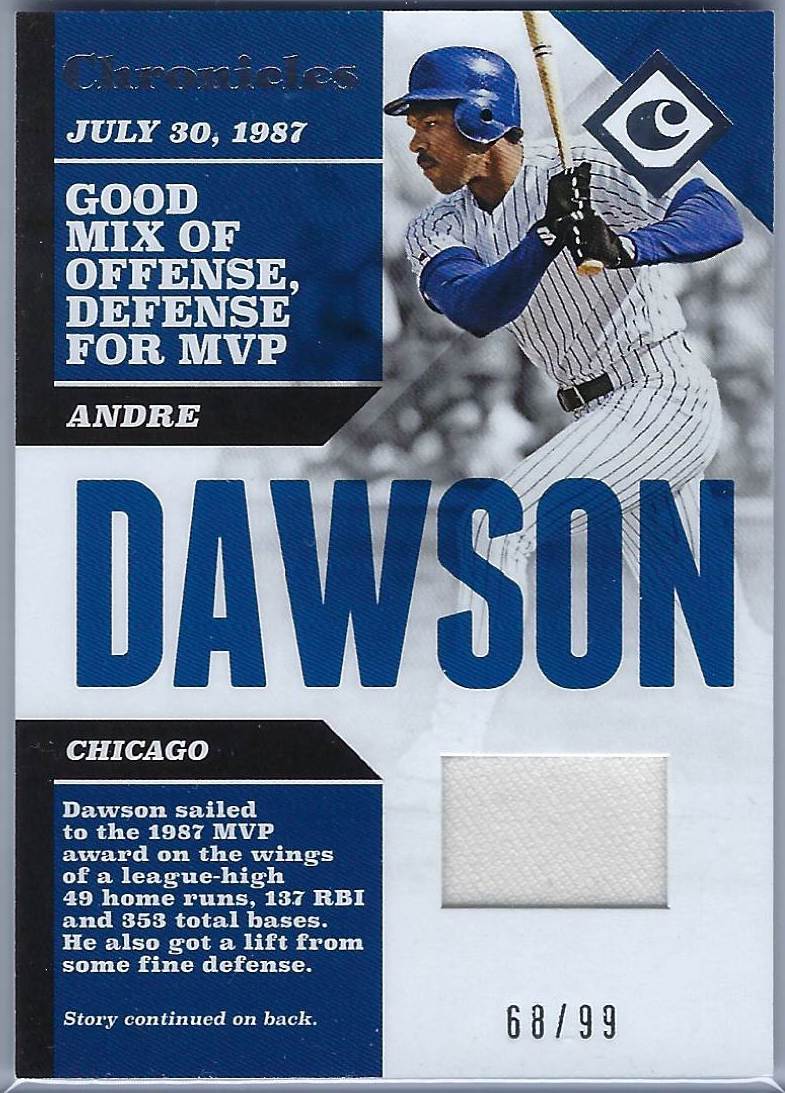
It really was like night and day between the 2017 and 2018 Panini Chronicles sets with the latter being an unbelievable improvement from the first set. With that said, some of the inserts and relics from the '17 product were at a much higher level than the rest of the set, ultimately inspiring what the 2018 product would look like.

The color scheme of this card, although rather basic, is very well-crafted, and the text is actually very interesting to read. My only complaint would be how small the jersey relic is, not even the fact that it's a plain white relic. There's certainly enough space to make the relic even the littlest bit larger.

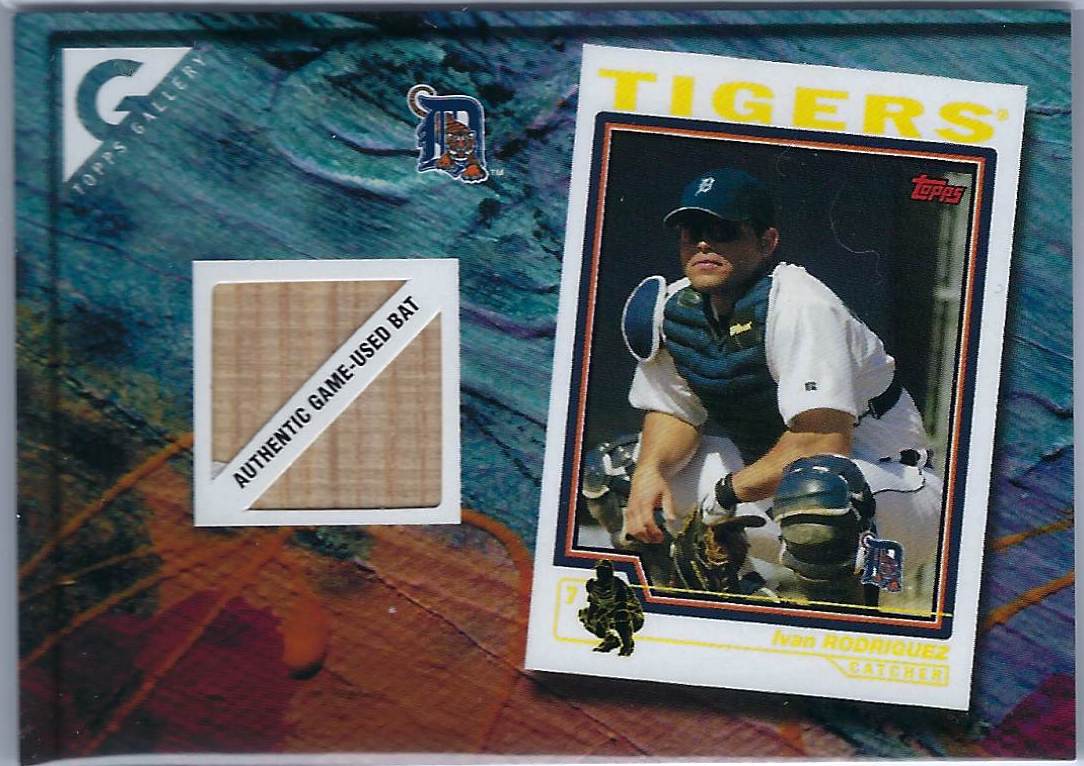
Topps Gallery produced some of the most creative and colorful relic cards of the early 2000s, and this Ivan Rodriguez bat relic fits that bill perfectly. The sheer abstractness of the card is quite appealing, even if I don't understand the inclusion of Rodriguez's 2004 Topps card next to the bat relic.

Like the Dawson relic, I'd only change one thing about the Rodriguez card; remove the banner that goes over part of the bat relic. There's a surplus of other places to include this information without cutting off the bat relic.

If there was ever a set that's perfect for black and white images, it would be 2001 Upper Deck Vintage. The photo of Fergie Jenkins in front of the Wrigley Field ivy and paired with a pants relic card helps me see why my Dad picked out this card with countless other options available. 

I don't even mind the fact that the relic is slightly blocked off, this time with seams of a Baseball because it's a far better fit for the card. Upper Deck tells me all about the game-used relic on the back of the card while letting the front of the card speak for itself. That is what a relic card should look like.

And if you ever find a bat relic of a member of the 500 home run club for less than $5, go for it. Even with the value of relic cards declining, there's definitely something to be said about game-used memorabilia of a Hall of Fame player, especially when that guy is none other than Mr. October, Reggie Jackson.

I'd always prefer the Athletics over the Yankees when it comes to Jackson, but the choice to show Reggie in a New York jersey makes sense for this card. He emerged as a true postseason phenom during his time in New York, and he was certainly a key part of the Yankees' success in the late 1970s.

After meeting up and showing each other what we'd purchased so far at the show, my Dad and I, with time running out, realized we had enough money in the budget for one final card that we'd both been eyeing all day long. 

This time, it wasn't a relic card, but an autograph of one of Boston's best current players, and it was serial numbered as well.

For roughly the price of a blaster box and a rack pack, we collectively decided on this gorgeous, on-card autograph of Red Sox ace Chris Sale from the 2018 Topps Finest set. A gold refractor, the card is serial numbered 6/50, and it helps me further boost the collection that I've put together of autographs and relics of members of the historic 2018 World Series team. 

I understand that pitcher's autographs don't typically sell for as much money as hitters', but it's nevertheless surprising to see this on-card auto for such a low price at a Baseball card show in the Boston area, especially since it's licensed and on-card. Not to mention, a gold refractor as well.

Chris Sale's signature may not be the best I've ever seen, but he's still one of the greatest players on the Red Sox roster, and he remains a vital part of their recent success. 

Especially after purchasing this card and the Triple Threads relic a month or so back, I'm praying that the Red Sox sign him to a major extension.

Wednesday, February 20, 2019

Coins & Chronicles; Card Show Recap #18 Part 2

After spending the first 45 minutes or so of Monday's card show finding cards from 1976 Topps, I knew it was necessary for me to look around and see what other vendors had to offer. 

Ultimately, this search brought me back to the same dealer that I purchased the vintage dime cards from. Amongst a stack of junk wax packs, I spotted a bunch of 1989 Topps Baseball Coins for only 25 cents a pack.

In what eventually became the easiest decision I made all day, I grabbed 8 packs for a mere $2 with each pack promising 3 coins. Oh, and a 30-year old stick of bubble gum as well.

Before I found these bargain packs at Monday's card show, I had only opened 1 pack of coin cards in my life, and the pack was from the mid-1980s. The 1989 Topps Baseball coins also inspired the blaster-exclusive coins from 2018 Topps Archives with both products utilizing the same design. 

Though I ended up with a few duplicate coins, I have zero room to complain at 25 cents a pack, especially since I ended up with an Eddie Murray coin on the LA Dodgers since he was one of the 3 players I pulled in my previous coin pack.

Even though this set was released just before the 90s officially began, the design still looks reminiscent of the late 70s and early 80s, featuring stars and bright colors. While the silver coins use a light green "wave," the gold coins' design features warmer colors like orange and yellow that, like the silver coins, change shades from beginning to end. 

The gold coins were where I had the must duplicate cards and the least amount of luck, yet even my dislike of steroid user Mark McGwire can't interfere with how well-made and sharp his '89 Topps coin appears.

After opening all 8 packs, I ended up with 2 All-Star coins that consist of much more colorful borders and a star-filled background. Walt Weiss isn't a player I'm super familiar with, but Tony Gwynn is a player that I collect, and his blue-bordered coin is instantly eye-catching.

I'll probably send out some in future team collectors packages, but 25 cents a pack is a heck of a deal for these sweet looking coins. However, the '89 Topps Baseball coins weren't the only packs that I opened at Monday's show.

Despite being unlicensed, 2018 Panini Chronicles will go down as one of my favorite Baseball card sets in recent memory, and I felt lucky to have picked up 3 blasters of the product at my local Target. 

I stayed away from hobby boxes and even hobby packs of the set due to the high prices, but I wasn't feeling incredibly inspired at the Mansfield show to search through dime boxes or Red Sox bins. 

After spending almost an hour looking for '76 and '79 Topps set needs, I didn't want to spend much more time looking through boxes. Because of that, I tested my luck with a single hobby pack of the Chronicles set and later returned to the same dealer for her final 2 packs from the product.

Among the dozen or more Panini products included in 2018 Panini Chronicles, there's Spectra, cards that fall at 2 per hobby box and feature numbered parallels and even autographs and relics. 

While my card isn't numbered, landing a card of Gleyber Torres, one of the top 5 rookies of 2018, demonstrates that you get a ton of bang for your buck when buying Panini Chronicles. Certainly, this is helped by the sheer strength of the 2018 MLB rookie class.

While I pulled either 3 or 4 numbered cards per blaster of 2018 Panini Chronicles, each hobby pack delivers a similar number, usually around 2 per pack. After all, with 15 or so products and 25 or more players per set, there's bound to be a surplus of numbered cards, especially when it comes to rookies. 

As far as the design goes, Crusade is easily one of the more creative products within the Chronicles set, a unique style that is aided by the untraditional choices for parallels. 

Numbered out of 199 copies, this ruby wave Rafael Devers rookie parallel is my 2nd serial numbered Devers card out of this product, the 1st of which being a blue cracked ice card from Contenders Optic.

While they don't have the licensing rights and won't until at least 2025, in the case of Chronicles, Panini more than makes up for it with unorthodox parallels, unique set designs, and one of the most creative products I have ever seen in my life.

While the "purple' parallel is only evident through the changing of the word Classics to purple, the card is nevertheless a serial numbered parallel. Better yet, it's numbered 10/10, tying it with a few other cards for one of the lowest serial numbered cards in my entire collection.

I don't know all that much about Mets shortstop Amed Rosario, but if I remember correctly, he was a high-ranked prospect before his rookie season in 2018. If he makes it big, I'll have a valuable card on my hands, and even if he doesn't, it's pretty cool to have a card that's numbered out of only 10 copies.

With hits falling at 4 hobby packs per 6-pack box, I was guaranteed at least 1 relic or autograph after purchasing 3 total packs, and it was the thinnest pack of the bunch that landed me an autograph card. 

This is the Panini Phoenix set design, one of a couple chrome stock card sets within Panini Chronicles. I'm not incredibly upset that I didn't land a huge name. Instead, I wish the autograph was on-card since a chrome set like Phoenix is basically perfect for on-card autos.

I happen to have 1 more hit to display to wrap up this post, but I felt it was necessary to show this card as well, the highlight of the 3 packs when it comes to parallels that I pulled. I couldn't care less about Panini not having the licensing rights, especially when I pulled this card. 

After all, it's a Shohei Ohtani pink parallel, numbered 8/25. Given what other copies of this same card appear to be going for on eBay, it looks as if I could pay for all 3 packs that I opened solely from this card. Because it's a rookie card, however, I'll likely be hanging on to this one.

As for the 2nd hit, it's hard to find a more beautiful card than this, and it's of a well-respected rookie from 2018 as well, St. Louis Cardinals pitcher, Jack Flaherty, from the hobby-exclusive Cornerstones set.

I can count on 1 hand how many autographed relic cards I have in my collection, nevermind an on-card auto with 4 relics, 2 of which are patches. Better yet, it's a rookie auto and a granite parallel as well, numbered 22/25 on the back which just so happens to be Flaherty's jersey number. 

With all the different elements of this card, you don't even notice the fact that it's unlicensed right away, and that's the sign of an excellent Panini Baseball card. All around, it's truly a fantastic card, and along with the Ohtani, was the highlight of this 3 hobby pack break.

After all, when you have a set as creative and loaded with as many top tier rookies as Panini Chronicles is, it's difficult, for me, to care all that much about there being no logos or team names.