My much-delayed 2020 Topps Heritage hobby box recap will be posted sometime this weekend, but before I get into a more in-depth analysis of this year's product, I thought I'd share a select few singles that I picked up before grabbing the Heritage box on release day just over a week ago.
When your spending money on a hobby box in general, you're not usually too inclined to splurge even more and grab some individual cards, but I figured it couldn't hurt to take a look. I purchased more cards than I actually chose to show, but they only added around $5 to the total cost.
Plus, I can't remember the last time I went on a dime box search: that is, giving myself a $20 budget and scanning through the cards until I reached the limit.
The whole process is wonderful because I end up with 200 new cards for my player collections that I can sort later that day, especially during the Baseball season when the Red Sox are playing.
I might be going off on a tangent and/or getting ahead of myself, but all this talk of dime boxes is inspiring me to get back to the card show and look through the bins. As I mentioned, it's been far too long since I significantly boosted my various PCs.
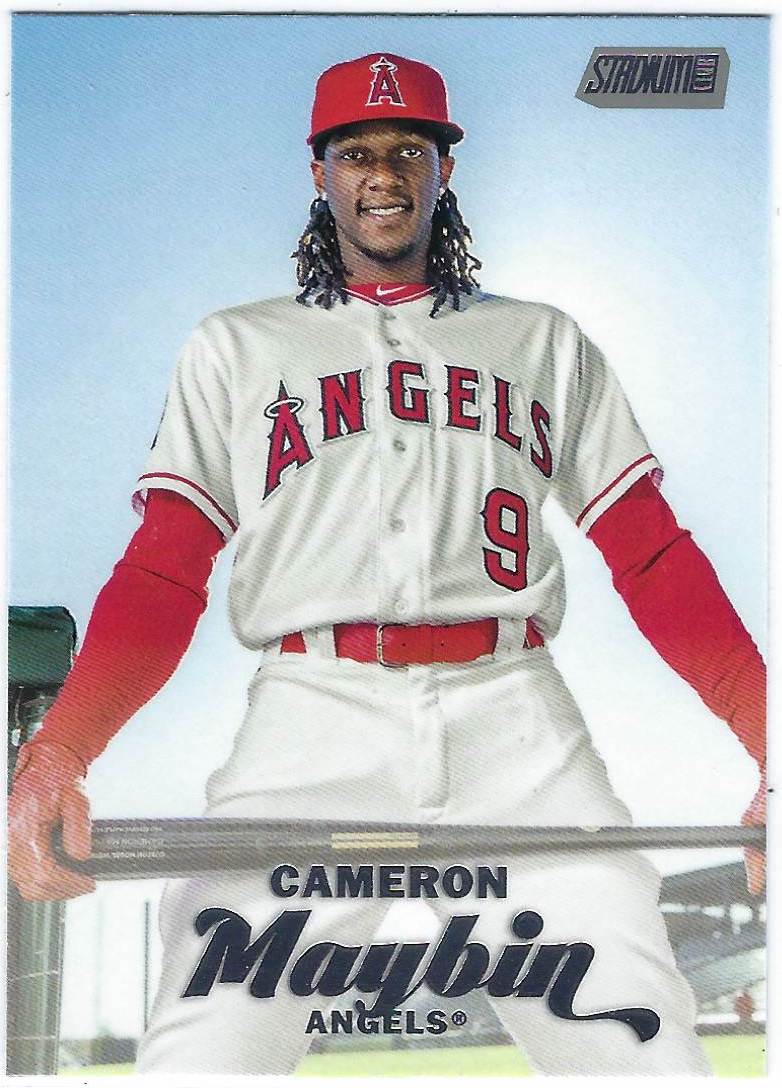
Moving on, I have a few cards that I specifically chose for today's rather brief post, starting with the one from the 2017 Topps Stadium Club set at the top of this post. No, I don't collect Willson Contreras, and I didn't necessarily choose this card because he plays for the Cubs.
Instead, it was the cameo that Aroldis Chapman made that sold me; 10 cents is well worth it for a parallel of a guy who played in Chicago for just half a season.
The Contreras card with a Chapman cameo didn't spell the end of my Stadium Club pickups. Despite how much 2018 I ripped, this is definitely my first time seeing the Carl Yastrzemski card, and I don't believe I'm familiar with the Ty Cobb either.
Some products end up in the dime boxes a lot more than others, but both Topps Stadium Club and Archives are pretty dependable in that, year after year, I can pick up singles for my player collections a week or 2 after release day.
Come to think of it, I can even wait 8 months and find new cards for my PCs in late February.
The 2 cards above were located directly next to one another in the order of the dime box, so for a quick second, I thought they were from the same set. As I soon found out, one is from Fleer Maximum Impact while the other is from Upper Deck SP Signature Edition.
Overall, Derek Jeter and Harmon Killebrew could not be more different. One was a contact hitter with superb defense while the other would've been a DH had it been implemented and focused on crushing homers rather than upping his batting average.
In my opinion, one of the better parts of specializing in player collecting is that you can find cards of all different players from virtually any era in Baseball history, allowing you to expand your repertoire as a baseball fan and card collector.
Plus, thanks to both Topps and Panini, both current, retired, and future players get their own cards thanks to the extensive range of different products.
As I've said before, there are abundances of cards from various sets/brands depending on when and where you search through the dime bins. In the case of my most recent visit to the card shop, that particular set was 2003 Donruss Team Heroes.
There were a few other cards in the Team Heroes stack, but the majority of them, oddly enough, featured members of the Chicago Cubs.
Though Ron Santo was not included, Jenkins, Sandberg, Banks, and Williams all were, so I'll definitely take this as a victory and an opportunity to enhance player collections from my 2nd favorite team.
I don't really have an effective way to transfer from 2003 Donruss Team Heroes to a "power plaid" parallel from 2019 Panini Prizm, but I wanted to save this card for last because it is a nice addition to my 2019 Panini Prizm project, which I haven't had the chance to add to in a while.
Anyone who follows my blog closely knows that I don't necessarily believe that I can achieve the goal of tracking down all parallels with print runs higher than 25 in a 300-card set, but I'm going to everything in my power to at least try.
Panini is going to release Prizm once again this year on May 13th. As much as I'll be tempted to rip into some packs, I'm going to give it my best effort not to open any of this product. Instead, I plan on saving the money I would've spent on the new release and concentrating on picking up singles for my project.
Whether or not that happens is an entirely different story.
A die-hard Red Sox fan collecting cards of Craig Kimbrel, the Red Sox, other players, and a whole lot more.
Showing posts with label Topps Stadium Club. Show all posts
Friday, March 6, 2020
Sunday, February 23, 2020
The New Frankenset: Page #5
It's been a while since I last updated the frankenset series with another post, so I thought that highlighting page #5 would be the perfect way to transition back into a somewhat regular schedule for the blog after being gone for most of the week.
The scope of this page, which features cards #37-45, is more limited than it's been in the past. The 1980s-2010s are represented, but there's only 1 card from the 80s, and it's from '89.
This page might not be one of my favorites, but there's still a fair amount to address; now, let's get started.
#37 2015 Bowman Prospects Archie Bradley
I don't remember exactly when I made this frankenset, but I wish I had chosen something a little more interesting than a 2015 Bowman base card.
Both the set design and the photo aren't all that interesting, and the foil text that makes up the player's name on the side of the card is notoriously hard to read. Fortunately, the subsequent cards on page #5 are at least a little more appealing.
#38 2003 Topps Finest
Thankfully, Frank Thomas' 2003 Topps Finest card is much more interesting, so it looks like this page is heading in a positive direction. People have often referred to this design as somewhat of a "beehive" thanks to the hexagons scattered throughout the background.
Furthermore, I usually prefer to see home uniforms on cards as opposed to the road, but there's something about the grey jersey that compliments the design better, in my eyes, than white would have.
#39 1997 Fleer Million Dollar Moments Ron Blomberg
In 1997 and '98, Fleer placed redemption cards in their products of all different sports which could, ultimately, result in a lucky collector winning $1 million. While I'm not sure if anyone was actually victorious, at least the design is pretty neat.
Blomberg is an interesting choice for the checklist considering he's a lesser-known player compared to guys like Babe Ruth and Cal Ripken Jr, but it's also highlighting the moment which was the introduction of the designated hitter.
#40 2003 Topps Stadium Club Orlando Cabrera
I don't know if any of you have seen the set design for the 2020 Topps Stadium Club set, but I must admit that I'm super excited to get a sampling of it upon the release in June. The lowercase letters and small, colorful banners make for an extremely modern design.
All Stadium Club sets, for that matter, use stellar photography to create an incredibly modern end product, and the 2003 set is no exception. The only way I could improve this card is by choosing a photo of Cabrera with a powder blue Expos jersey.
#41 2015 Bowman Matt Shoemaker
There's nothing else I want to say about the 2015 Bowman design, so I'll instead talk about Matt Shoemaker, the subject of the card who was en route to an All-Star season with the Blue Jays last year before getting injured.
Hopefully, he can return in 2020 and stay healthy, maybe even take home the AL Comeback Player of the Year award while he's at it.
#42 1994 Ted William Card Company Ralph Garr
1994 was the 2nd and final year of the Ted Williams Card Company, and while the set was only produced for a brief amount of time, they succeeded in highlighting underrepresented players from the game's extensive history.
Guys like Ralph Garr, Thurmon Munson, and Sal Bando, among others, were featured in the checklist over the product's 2-year history. I've completed both of the base sets and even opened hobby boxes from '93 and '94.
#43 2006 Topps Laynce Nix
As far as the 2000s Topps Flagship sets go, 2006 falls roughly in the middle. It's not catastrophic, but there's nothing all that special about the design. It does feature colors that line up with that of the respective team, but that's about it.
If they removed the foil text that spells out the team/player name as well as the position, I'd be slightly more fond of this design. Hopefully, by now, card companies have learned that we don't like foil text on cards whatsoever.
#44 2009 Topps Allen & Ginter Freddy Sanchez
The card above might very well be my favorite of the entire page, though, to no one's fault but my own, there wasn't a whole lot of competition.
Both the photograph and the design are different from what we typically see out of Allen & Ginter, and the Pirates uniform, which they no longer wear, brings back vivid memories of late-2000s Baseball.
#45 1989 Score Willie Randolph
Aside from the obvious, damaged corner in the top righthand corner, the rest of this 1989 Score Willie Randolph card is in reasonable shape. By this point in his career, on the other hand, Randolph was past his prime.
Granted, he went on to be an All-Star for the 6th and final time in '89, this time with the Dodgers, but he wouldn't match the numbers he put up for the 1977 and 1978 World Champion New York Yankees ever again.
The scope of this page, which features cards #37-45, is more limited than it's been in the past. The 1980s-2010s are represented, but there's only 1 card from the 80s, and it's from '89.
This page might not be one of my favorites, but there's still a fair amount to address; now, let's get started.
#37 2015 Bowman Prospects Archie Bradley
I don't remember exactly when I made this frankenset, but I wish I had chosen something a little more interesting than a 2015 Bowman base card.
Both the set design and the photo aren't all that interesting, and the foil text that makes up the player's name on the side of the card is notoriously hard to read. Fortunately, the subsequent cards on page #5 are at least a little more appealing.
#38 2003 Topps Finest
Thankfully, Frank Thomas' 2003 Topps Finest card is much more interesting, so it looks like this page is heading in a positive direction. People have often referred to this design as somewhat of a "beehive" thanks to the hexagons scattered throughout the background.
Furthermore, I usually prefer to see home uniforms on cards as opposed to the road, but there's something about the grey jersey that compliments the design better, in my eyes, than white would have.
#39 1997 Fleer Million Dollar Moments Ron Blomberg
In 1997 and '98, Fleer placed redemption cards in their products of all different sports which could, ultimately, result in a lucky collector winning $1 million. While I'm not sure if anyone was actually victorious, at least the design is pretty neat.
Blomberg is an interesting choice for the checklist considering he's a lesser-known player compared to guys like Babe Ruth and Cal Ripken Jr, but it's also highlighting the moment which was the introduction of the designated hitter.
#40 2003 Topps Stadium Club Orlando Cabrera
I don't know if any of you have seen the set design for the 2020 Topps Stadium Club set, but I must admit that I'm super excited to get a sampling of it upon the release in June. The lowercase letters and small, colorful banners make for an extremely modern design.
All Stadium Club sets, for that matter, use stellar photography to create an incredibly modern end product, and the 2003 set is no exception. The only way I could improve this card is by choosing a photo of Cabrera with a powder blue Expos jersey.
#41 2015 Bowman Matt Shoemaker
There's nothing else I want to say about the 2015 Bowman design, so I'll instead talk about Matt Shoemaker, the subject of the card who was en route to an All-Star season with the Blue Jays last year before getting injured.
Hopefully, he can return in 2020 and stay healthy, maybe even take home the AL Comeback Player of the Year award while he's at it.
#42 1994 Ted William Card Company Ralph Garr
1994 was the 2nd and final year of the Ted Williams Card Company, and while the set was only produced for a brief amount of time, they succeeded in highlighting underrepresented players from the game's extensive history.
Guys like Ralph Garr, Thurmon Munson, and Sal Bando, among others, were featured in the checklist over the product's 2-year history. I've completed both of the base sets and even opened hobby boxes from '93 and '94.
#43 2006 Topps Laynce Nix
As far as the 2000s Topps Flagship sets go, 2006 falls roughly in the middle. It's not catastrophic, but there's nothing all that special about the design. It does feature colors that line up with that of the respective team, but that's about it.
If they removed the foil text that spells out the team/player name as well as the position, I'd be slightly more fond of this design. Hopefully, by now, card companies have learned that we don't like foil text on cards whatsoever.
#44 2009 Topps Allen & Ginter Freddy Sanchez
The card above might very well be my favorite of the entire page, though, to no one's fault but my own, there wasn't a whole lot of competition.
Both the photograph and the design are different from what we typically see out of Allen & Ginter, and the Pirates uniform, which they no longer wear, brings back vivid memories of late-2000s Baseball.
#45 1989 Score Willie Randolph
Aside from the obvious, damaged corner in the top righthand corner, the rest of this 1989 Score Willie Randolph card is in reasonable shape. By this point in his career, on the other hand, Randolph was past his prime.
Granted, he went on to be an All-Star for the 6th and final time in '89, this time with the Dodgers, but he wouldn't match the numbers he put up for the 1977 and 1978 World Champion New York Yankees ever again.
Saturday, July 6, 2019
Be Back Soon
Since I started blogging in August of 2017, I haven't taken a break longer than 2 days from posting. For whatever reason, I've always felt the need to post as often as possible, usually resulting in 24 or 25 posts each and every month.
Now, for the first time, I'll be taking more of an extended break from the blog. Not because I've run out of ideas or desperately need a break from posting almost daily, but because I'm going on vacation for the next 13 days.
I haven't been on a vacation since my trip to The National last year, and I still managed to post during some of my days in Cleveland. However, throughout my time in Washington DC and North Carolina, I'm going to be too busy to write high-quality posts.
I value quality over quantity, and I feel like there have been some instances on the blog in which that notion hasn't held true. Thus, I have no problem taking this break from blogging, though I foresee myself returning to my normal posting schedule on July 19th or 20th.
As a result, this will be my final post for the next 2 weeks or so, and it's a quick recap of a trip that I took to my LCS earlier in the week. It's become a regular occurrence for me to, in addition to necessary supplies, pick up some dime and 50 cent cards while browsing through the card shop.
While I'm away, Panini Donruss Optic and, more notably, Topps Allen & Ginter are going to be released. While I've never opened a pack of Optic in my life, A&G is an essential release for me, year in and year out.
However, this shouldn't be too much of a concern, for I can pick up what I want from both of these sets when I arrive in Chicago for The National at the end of this month.
Since my Dad and I visited the dime boxes at our LCS a couple weeks beforehand, the selection of available cards didn't change all that drastically. However, we still found a reasonable number of cards; some were for our player collections while others were not.
Take the 4 cards above, for example. Only 1 of them (the Jimmy Dean George Brett) will immediately be going to a player collection. Truth be told, I really should start collecting Francisco Lindor along with many other players.
I should remind myself to add some new PCs to my collection when I return home. Guys like Lindor, Freddie Freeman, Ronald Acuna Jr, and Gleyber Torres should be added to my list of 250 PCs.
Following Ichiro's retirement after the 2-game series between the Mariners and Athletics in Japan, the 45-year old retired. This made Albert Pujols the largest of my active player collections at 161 total cards, a number that'll be boosted thanks to these 2 Stadium Club base cards from 2015 and 2016 respectively.
I've ranted about Stadium Club quite a bit in the last week, but I just love the wide range of various cards throughout the set and even across each release. Although these 2 cards are from the same product and are just 1 year apart, they're incredibly different. That's not something that you can find in every Baseball card set.
Speaking of Topps Stadium Club, I picked up a couple of cards from the 2017 set that, come to think of it, I might already have in the Rod Carew and Paul Goldschmidt PCs.
However, I wasn't as certain when shuffling through the dime bins, and if there's any set that I'll accept doubles from more than others, it's Stadium Club.
I'm not sure who brought that painting of Paul Goldschmidt to the Arizona Diamondbacks game, but I truly hope that he signed it. That would be a one of a kind collectible. As for Rod Carew's card, he's also signing autographs for fans before the game, a similarity between the 2 cards that I didn't notice beforehand.
The tragic death of Los Angeles Angels pitcher Tyler Skaggs earlier in the week brought back painful memories of the Baseball players that we've lost over the last few years. Jose Fernandez, Yordano Ventura, Jose Castillo, Luis Valbuena, and Roy Halladay have all passed away since September of 2016.
I remember hearing the news of all of these player's devastating deaths, and it's incredibly unfortunate that history has repeated itself numerous times over the last few years. I picked up this Halladay card the day after Skaggs' passing, and it brought all of those memories back.
RIP Tyler Skaggs.
I don't want to end this post on a depressing note, but I felt compelled to address what happened earlier this week. Moving on, we have a couple of Bowman's Best cards for 2 of the brightest stars in the National League.
The card of Dodgers shortstop Corey Seager, who I wrote a top 5 cards post for on Thursday, is an insert from the 2016 Bowman's Best set, making it a card from the rookie season of the 25-year old.
Although it's challenging to tell, the Paul Goldschmidt card is a refractor from the 2018 Bowman's Best set, back when he was still with the Arizona Diamondbacks. More so than most of the extensions signed over the offseason, Goldschmidt's surprised me, for he had never played a game for St. Louis at the time of the contract.
With that being said, he's been one of the most consistent players in Baseball over the last 5 years, so I have reason to suspect that the signing will work out for both sides.
Finally, we have a "felt" (I don't know what they're really called) card of J.D. Martinez from 2019 Topps Heritage, another player who I have no excuse not to collect cards of.
Seriously, he was one of the best players on the World Champion Boston Red Sox team, and he's been an All-Star each of his first 2 seasons in Boston.
On that note, I have a few final things to do before I leave for DC tomorrow morning and take my first ever extended break from the blog.
I hope you all have a great 2 weeks, and I look forward to getting back into the swing of things later this month.
Thursday, July 4, 2019
Top 5 Cards; Corey Seager
To put it mildly, the last year or so has not been kind to Los Angeles Dodgers shortstop Corey Seager. In addition to missing most of the 2018 season with a UCL injury, he's been sidelined for almost a month of the 2019 season with a hamstring strain.
I've been a fan of Seager's since his 2016 NL Rookie of the Year campaign. The 2-time All-Star has clearly had his fair share of injuries since making debut in 2015, but he's only 25 years old.
Because he's played for the Dodgers his whole career, Seager already has a ton of playoff experience under his belt, most notably the 2017 World Series appearance. Unfortunately, his UCL injury prevented him from contributing to LA's Fall Classic run last year.
Corey Seager was on-track for a bounce-back season in 2019 before he went on the injured list last month. When he and the 2017 NL Rookie of the Year award winner Cody Bellinger are at their best, it's challenging to find a more productive and young duo in all of Baseball.
It's been a while since we've seen Bellinger and Seager playing together while completely healthy. I don't know too much about the severity of the latter's injury, but I'd like to see him back to 100% in order to help the Dodgers make a playoff run later this season.
After losing consecutive World Series, the 2019 LA Dodgers team appears to be the most dynamic team in decades. If both the Red Sox and the Cubs miss out on the Fall Classic, I wouldn't mind seeing the Dodgers take him the Commissioner's Trophy.
My Corey Seager player collection consists of 59 cards, a reasonable total considering that he's only been in MLB since 2016. I have quite a wide range of cards in my Seager PC, so I actually enjoyed narrowing the group down to my 5 favorites.
#5 2018 Topps Chrome
I've been a fan of Seager's since his 2016 NL Rookie of the Year campaign. The 2-time All-Star has clearly had his fair share of injuries since making debut in 2015, but he's only 25 years old.
Because he's played for the Dodgers his whole career, Seager already has a ton of playoff experience under his belt, most notably the 2017 World Series appearance. Unfortunately, his UCL injury prevented him from contributing to LA's Fall Classic run last year.
Corey Seager was on-track for a bounce-back season in 2019 before he went on the injured list last month. When he and the 2017 NL Rookie of the Year award winner Cody Bellinger are at their best, it's challenging to find a more productive and young duo in all of Baseball.
It's been a while since we've seen Bellinger and Seager playing together while completely healthy. I don't know too much about the severity of the latter's injury, but I'd like to see him back to 100% in order to help the Dodgers make a playoff run later this season.
After losing consecutive World Series, the 2019 LA Dodgers team appears to be the most dynamic team in decades. If both the Red Sox and the Cubs miss out on the Fall Classic, I wouldn't mind seeing the Dodgers take him the Commissioner's Trophy.
My Corey Seager player collection consists of 59 cards, a reasonable total considering that he's only been in MLB since 2016. I have quite a wide range of cards in my Seager PC, so I actually enjoyed narrowing the group down to my 5 favorites.
#5 2018 Topps Chrome
Given all the various inserts and prospect cards that make up my Corey Seager player collection, I surprised myself by selecting his base card from 2018 Topps Chrome to crack the top 5. Rarely do I see Flagship/Chrome base cards at the same level as other products like Stadium Club and Archives.
However, I'm a stickler for chrome stock cards as a whole, and this isn't your traditional photo from a Topps Flagship set. In fact, I recall seeing a card quite like this in my 2019 Topps Stadium Club box break, so that shows the caliber of this picture and why I believe it's worthy of the top 5.
Now, if only I had a refractor version of this card, particularly blue to match the Dodgers' team colors.
#4 2015 Bowman Chrome Prospect Profiles Mini Refractor
While attending a Baseball card show last year, I stumbled upon a plethora of Corey Seager prospect and rookie cards, including a rare rookie from Topps Tribute and the Bowman Chrome mini above.
Though the Tribute rookie was an insane bargain, I didn't deem it as worthy of making the top 5 as this tallboy-style mini. The shape of the card, for starters, is something that we virtually never see in today's card collecting world. Furthermore, there's something about the actual image that was chosen that ties everything together.
#3 2016 Topps Chrome Perspectives
The fact that we never saw the Topps Perspectives inserts after the 2016 season is a shame, for they were a fairly common insert with Stadium Club-style photography. At least Topps included them in the '16 Chrome set as these cards look sensational on chrome cardstock.
This picture of Corey Seager truly resembles something that we'd see in Stadium Club, from the angle of the photography to the superior quality. Even though I could do without his name taking up so much background space just like all the other Perspectives cards, that issue is insignificant.
I realize that Topps already produces a set that's known for its photography, but I, for one, wouldn't mind a little bit of SC in Topps Flagship and Chrome.
#2 2017 Topps Archives 1959 Bazooka
The 2nd "tallboy" card on this list is an insert from the 2017 Topps Archives set, replicating the original 1959 Bazooka cards. I had the pleasure of seeing one of the originals in person at the Mansfield show earlier this year, so I can thoroughly say that Topps did a fabulous job recreating them.
I have this exact insert for a couple other players that I collect (Judge, Pudge, Ryan), but Seager's recognizable smile combined with the classic red and blue color combo makes this card one of the best.
Similar to how I'd like to see Perspectives revived for subsequent Topps Flagship sets, I'd love to see some tallboy inserts or even a set produced by Topps in the near future. Judging from the 2 minis on this list, it looks like they've done an excellent job.
#1 2016 Topps Stadium Club Black Parallel
I vividly remember pulling this rookie card parallel out of a Fairfield 20-pack repack box towards the beginning of 2017 along with a 2015 Topps Series 2 Kris Bryant rookie card.
While I haven't seen a single one of those Fairfield repacks since, I'm grateful that they were available for me to purchase, for they delivered some fabulous rookie cards for my collection.
To be honest, I would've been content with a base rookie of Corey Seager, but the fact that it's a black foil parallel only makes it rarer and more valuable. Plus, the card is from Stadium Club, so there's sensational photography as a bonus.
Writing this post only makes me like Seager as a player even more. He's an awesome guy to collect, and I've accumulated some stellar cards of his over the years.
Hopefully, he can recover quickly from his injury and get back to doing what he does best, contributing to the Dodgers and their success.
Friday, June 28, 2019
Ranking the 2019 Panini Prizm Inserts
Within the last month or so, the Target near me completed major renovations that altered both the appearance and the availability of products throughout the store. While the layout is more or less the same, everything looks drastically different, including the Baseball card section which I frequent often.
Beforehand, all of Target's trading cards were grouped together in an aisle near the registers farthest away from the entrance. Even though I haven't always found exactly what I'm looking for in the card aisle, I appreciate the fact that everything was grouped together in one section.
Unfortunately, that philosophy did not carry over to the newly-designed Target, for the Baseball card aisle is now a shadow of its former self. Half of the space is now occupied by an irritating wall of gift cards and 1/4 of the aisle consists of non-sport trading cards.
This leaves a tiny sliver reserved for sports cards, and not all of that is Baseball. There are some Basketball and Football products scattered about, and I didn't spot a single product that was released within the last month.
As poor as the selection is now, I fear it will only get worse as I found no Stadium Club or Series 2 blasters on the shelf.
When walking around the redesigned store, I discovered a couple makeshift Baseball card "displays" located within the Boston sports memorabilia section. I put the word display in quotation marks because, at most, these shelves consisted of a couple of Gypsy Queen blasters and a Series 2 rack pack.
No Stadium Club whatsoever. No Series 2 hanger boxes or blasters. I fear that this is the end of my retail shopping at Target. Alas, I picked up a value pack of 2019 Panini Prizm in an effort to make progress with my insane 2019 Panini Prizm project, and I left Target for good.
From that value pack, I got the idea to rank the inserts from 2019 Panini Prizm, for, after seeing the redesigned Target, I doubt I'll get my hands on any 2019 Topps Stadium Club unless I venture into a hobby shop.
#9 Scorching
I didn't know how to describe my dislike towards the Scorching inserts of 2019 Panini Prizm until I watched a hobby box break of this set on YouTube. The collector referred to the inserts as "cheesy," and I couldn't agree more.
The flames in the background, truthfully, look awful. Topps has pulled off insert sets in the past that utilize fire, but it seems that Panini didn't take any pointers when it came to Scorching. If Panini's goal was to display the top flamethrowers in the game, try a flaming Baseball instead.
I'll admit that it would be challenging to make these cards not appear cheesy, but Panini didn't do themselves any favors with the design. Ultimately, the cards came off, to me, as cheap.
#8 Brilliance
Like Scorching, Brilliance is an insert set dedicated solely to pitchers. Although the design is a substantial improvement from the previous entry, these inserts lack a crucial quality; uniqueness.
If nothing else, the Scorching cards had a theme behind them; they highlight the fastest throwing pitchers in Baseball. On the other hand, there's nothing that special about the Brilliance cards.
Rather, they feature the best pitchers in Baseball, like Verlander, Sale, and Scherzer, but the cards themselves don't have much of a personality. If not for the design, I'd rank Brilliance last, but the pink and purple background elevates these inserts to the #8 spot.
#7 Machines
Conversely, the Machines inserts showcase the top sluggers in Baseball, similar to how Brilliance features the game's most dominant pitchers. As a result, I have similar problems with this insert set as I do with the previous one.
In some areas, Machines departs from the Brilliance cards, for the former has more of a distinct theme (power hitters) and an interesting design. The reason why I placed these inserts above Brilliance is that it's a slightly improved version of the pitchers-only insert set.
All in all, these inserts are on the average side, which would make their ranking a bit higher in almost any other product. However, there are some surprisingly strong inserts in 2019 Panini Prizm, so the highest I could rank Machines is #7.
#6 Fireworks
As I continue this countdown, I'm struggling to decide which quality I prefer in an insert set; a central theme or an interesting set design. Towards the top of the list, a few of the cards combine these 2 characteristics, but right now, I have to decide between the 2.
Most of the cards so far have had fairly weak themes, and the same could be stated about the Fireworks inserts, one of which is showcased above. As I mentioned, some inserts have a better them than others while additional inserts have a more compelling design.
Clearly, the Fireworks cards have a beautiful design despite lacking a concrete concept behind the actual insert set. The cards are easily the best looking on the list thus far, and I'm willing to accept the lack of a theme behind these cards and place the Fireworks inserts at #6.
#5 Illumination
If I was determining the inserts' placements on this countdown solely based on design, Illumination would definitely crack the top 2 or 3. I pulled 6 of these from 2 hobby boxes and some retail Prizm packs, and I can thoroughly say that these cards, especially the holo versions, are stunning in person.
Unfortunately, Illumination struggles with what virtually every insert set has suffered from so far on this list; there's no real rhyme or reason behind these cards. They may be vibrant and colorful, but that doesn't tell you much about the cards themselves.
The top 4 insert sets on this list all combine a compelling set design with a profound concept. As a result, Illumination's gorgeous cards simply weren't enough to rank higher on the countdown.
#4 Instant Impact
It's taken 6 insert sets, but we finally have a set of cards that combines a distinct theme with stellar set design, resulting in a fabulous insert set overall.
These Instant Impact cards, as the title suggests, feature players that had an immediate and profound impact as soon as they made their debut for their respective MLB teams. I assume that these cards are rarer than most of the other inserts, for I only pulled 2 out of all the 2019 Panini Prizm that I opened.
Still, the 2 cards that I ended up with (Torres and Flaherty) are awesome cards with equally impressive information on the back. Unlike most of the sets thus far, Instant Impact has a definite theme.
#3 Numbers Game
This isn't the first time that we've seen Numbers Game inserts in recent years, for Topps Allen & Ginter made a Numbers Game insert back in 2016 that differed somewhat from the 2019 Panini Prizm version.
While I'd prefer to have the background colors and numbers to be full-bleed, I have few issues with the Numbers Game insert set. In addition to including the player's jersey number in the bottom left corner, these cards feature a plethora of numbers in the background, mainly the players' stats from last season.
I'll give Panini points for uniqueness and creativity because I haven't really seen anything like this before. Also, considering that I only pulled 3 of these inserts, I'd say I did pretty well (Acuna Jr, Betts, and Soto).
#2 Lumber Inc
In the past, numerous cards and even entire sets have been based on bats and lumber (i.e. the Donruss/Panini Leather & Lumber product. In the case of 2019 Panini Prizm, they took this basic idea and transformed it into something that fit the bill for the product while also standing out.
Personally, I'd never pair lumber with chrome stock cards, but Panini opted to do so, and the results say it all. I've always thought of lumber, when it comes to Baseball cards, as bat relics or cards with a wooden finish. Never would I expect cards like this in Panini Prizm, but I sure am impressed.
#1 Star Gazing
I know that I've stressed the importance of having a concrete theme behind insert sets throughout this post, but I'm willing to make an exception if and when an insert set's design is simply phenomenal, and that's exactly how I feel about the Star Gazing inserts, my favorite of the entire 2019 Panini Prizm set.
My only issue with this set is the background is the same for all the cards, but the combination of the surplus of colors and the different positions of each player allows every card in the insert set to stand out. Seriously, it's hard not to get mesmerized by the intricate and gorgeous background.
Star Gazing may not be as conceptual of an insert set as Instant Impact or even Machines, but the cards are beautiful enough to earn the #1 spot, and this was not a decision that I made lightly.
Friday, May 10, 2019
Ranking the Modern-Day Topps Stadium Club Sets
Since the brand's revival in 2014, Topps Stadium Club has enjoyed a great deal of success. Card collectors have consistently ranked this photo-centric product as one of the greatest, if not the best releases year after year.
Over the last half-decade, Stadium Club has improved drastically. Though the inserts still leave something to be desired, the 300-card base set features a blend of current and retired players that works to perfection.
The center point of the entire product, the photos, are stunning, some even breathtaking works of art that belong in a museum. No matter the year, each of the 5 modern-day Stadium Club sets thus far (2014-2018) has produced at least 1 unbelievable card that is often ranked as one of the greatest Baseball cards of the entire year.
From the Sandy Koufax card in 2016 to the Ted Williams from last year, Stadium Club consistently produces fantastic cards, making this product one of the most anticipated releases year after year.
I know that I, along with countless other collectors, am counting down the days until 2019 Topps Stadium Club is released on June 26th. The current mock-ups of the base cards on COMC and Beckett look absolutely phenomenal, to put it mildly.
Both the photo choices and, to a lesser degree, the set design, contribute to the success and popularity of a Stadium Club set. Nailing both of these aspects is essential towards producing the best possible product, something Topps has accomplished a couple of times over the last few years.
As you can tell, the subject of today's post will be the Stadium Club brand. Specifically, I'll be ranking the 5 sets released thus far and assessing them based on how well or poorly they fit the criteria I mentioned in the previous paragraph.
2014 Topps Stadium Club
The first Topps Stadium Club release in almost a decade, the 2014 set ushered in a new era for this photography-based brand. Finally, after Topps made a couple of attempts with this product, Stadium Club was back with an identity. However, that doesn't mean the '14 set and design was all that stellar.
For starters, the design resembles exactly what I didn't like about the Stadium Club sets of the 90s and 2000s; it's incredibly boring. The card backs are fine, nothing much to talk about, but when compared with the subsequent releases, the photography behind the 2014 set fails to impress.
There are still some fabulous cards in 2014 Topps Stadium Club, but it's rather pale in comparison with other releases. However, this was the first release of this product's revival, so I'll cut Topps some slack.
2015 Topps Stadium Club
Wisely, Topps opted for a borderless, minimal set design the following year in order to allow the photography to stand out more than it ever had before. Moreover, Topps stepped their game up when it came to pictures as well, for 2015 Stadium Club notably featured more stand out pictures than the 2014 set.
Although like the first edition, this product has its flaws, 2015 Stadium Club helped set the tone for what future releases should be like. As you'll notice, subsequent Stadium Club products feature similar set designs, card backs, and selection of photography.; much of this is thanks to the 2015 release.
2016 Topps Stadium Club
One of my favorite Stadium Club releases to date, 2016 Topps Stadium Club features the strongest set design among the 5 products thus far, but that could change following the release of the 2019 product later this year.
Regardless, 2016 was a strong and impressive year for the brand as Topps boosted their set even more. This was also the year in which I began taking notice of the Stadium Club product, after which my collecting habits would forever be changed.
I'm such a huge fan of the 2016 Topps Stadium Club that I'm willing to completely ignore the fact that it looks very reminiscent of 1997 Fleer.
2017 Topps Stadium Club
Personally, I view the 2017 Topps Stadium Club as the greatest release in this product's complicated history. Not only are both the card backs and the set design top tier, but the photographs featured are just insane.
Some of the greatest cards of the modern era (Brooks Robinson, Reggie Jackson, Tim Raines) come to mind when I think about this sensational product. If that wasn't enough, we got to see some unconventional players featured in the base set as retired players, like Bobby Abreu and Derrek Lee.
I'm not trying to knock the 2018 set whatsoever, but I believe, as of now, Topps Stadium Club peaked in 2017.
2018 Topps Stadium Club
I truly don't have any problems at all with the 2018 Topps Stadium Club set. The photos featured are fantastic, including some true gems, like the previously mentioned Ted Williams card. The backs and the set design are stellar, and, most importantly, it stays true to the concept that Stadium Club has been executing for years now.
However, following the massive success that was 2017 Topps Stadium Club, the following release took a minor step back. Don't get me wrong, I still love the '18 set; it's just that 2017 was truly incredible.
As we inch closer to the release of the 2019 checklist and, eventually, the set itself, I'm intrigued to see how it falls in comparison with the first 5 releases.
Friday, November 23, 2018
Card Shows > COMC Sales; Card Show Recap #15
After what was a relatively long debate, it was decided that I would skip the annual COMC Black Friday sale and instead, take a trip to the once-a-month or so Mansfield sports card show. Rather than waiting in line with dozens of other people at a Target or some other store, I'd much rather be at a baseball card show, searching bins of cards.
I'll spend the next couple days or so to talk about how special this show was, but I'll start off with something that I search for at nearly every show I've ever attended.
Dime boxes.
Yes, even at a card show with around 70-80 vendor tables, I still couldn't resist the urge to go through a row of my favorite dime boxes at the show from a dealer I've been doing business with as long as I can remember. Plus, due to how crowded his booth was, he allowed me to take a box into the hallway and pick out what I wanted there. How could I possibly say no?
Even though I'm not actively collecting the massive set that is Panini Chronicles, I'm piecing it together with whatever I can find for a good enough price. That said, I wasn't expecting the 2 per hobby box Spectra cards to be in the dime bins, let alone a parallel of one of them numbered out of 99.
Consisting of all rookies, the 4 Spectra cards I found were definitely a shock, but I knew that even though I don't collect any of the players and will likely never complete the set, they'd make awesome additions to my collection of 2018 Panini Chronicles cards.
While I'm talking about unlicensed cards, I should definitely make note of the abundance of Panini Donruss Optic parallel cards in the dime boxes today with specific players appearing more so than others. In fact, I spotted 3 players with 2 different parallels in the bin, the first being Salvador Perez. The orange is not numbered while the aqua parallel is serial numbered out of 299 copies.
Next up is Dallas Keuchel, the free agent lefty who I also picked up a duo of Donruss Optic parallels of. The orange on the left is the same as Perez's first parallel while the 2nd is some sort of orange and yellow combination that I can't seem to identify, but it too is not serial numbered.
Finally, the last of the 3 players is Mets pitcher Noah Syndergaard who, unlike Perez and Keuchel, had 2 different numbered cards as opposed to 1 or 2 non-numbered parallels. First up is what I believe to be a red parallel numbered out of 199 while the 2nd card is a Diamond Kings card with another parallel that I can't seem to identify. That one is numbered 50/50, a true steal for only a dime.
Wrapping up a majority of what I picked up for unlicensed cards is a duo of Panini Donruss Aurora inserts from 2018, an insert set I'm very pleased Panini decided to bring back. Like the 2017 versions, the Aurora inserts are vibrant with tons of bright and eye-catching colors. The 2 players I picked up, Ichiro and Buster Posey, are both at or very near 100 cards with Ichiro currently closing in on 200.
Speaking of top-tier players collections, guys like Ichiro and Ken Griffey Jr. benefited from the dime boxes, as usual, this time with cards from the 2007 Bowman's Best set. Like the Aurora cards, the 4 guys of whom I found Bowman's Best cards are all players I heavily collect, 3 of them being Gold Tier PCs.
Bowman's Best was far from all that I brought back of high-end cards. A couple 2013 Topps Tribute World Baseball Classic cards found their way into the bin which was met with appreciation on my part. After deciding only 2 picks up cards of guys I collect, 3 players (Joey Votto, Jimmy Rollins, and Miguel Tejada) were chosen, players from 3 different countries (Canada, Dominican Republic, and the U.S.).
Rounding out the rest of the high-end cards I brought back is another addition to my Corey Seager player collection which has become abundant with lots of prospect cards, parallels, and rookie cards. This time, the newest addition is a Topps Museum card from his rookie 2016 season.
With all the various sets put out, especially by Fleer and Donruss, in the early 2000s, it's difficult for me to be familiar with each and every one of them. Up until today, I had little to no knowledge of the Donruss Greats set having only recognized 1 year or so of the set.
With the help of these 4 cards from 2 different sets, I'm able to gain the slightest bit more knowledge of past released and picked up some nice cards for a few '70s and '80's PCs while I was at it.
I suppose the same could be said for this set from 1996 though I'm still not certain what the set is referred to as. Even so, knowing the name would help my understanding of the confusing decade of cards that is the 1990's. Plus, once again, I'm able to boost a couple player collections along the way.
The things I've been talking about are major aspects of what makes the dime bins so enjoyable and interesting to look through, even if it means limiting the number of new vendors I'd get to do business with. By finding new products and insert sets, I'm able to develop a deeper understanding of the crazy and sometimes overwhelming hobby of collecting cards.
Guys like Vladimir Guerrero were examples of common denominators between the 2 different insert sets I found from the 2001 Upper Deck Vintage product, the first year of that specific Upper Deck set. The simple black and red combo make the Retro Rules cards appealing, but it's the font used for Matinee Idols that makes the card look almost like a comic book, especially with the green or red color in the background.
If I'm not mistaken, 2014 was the very first year of the revived Topps High Tek brand, a set that's been going strong with 5 different releases and the creation of Bowman High Tek, both of which have become extremely popular with higher-end collectors.
The different patterns made me pay extra attention when looking through these cards of Nomar Garciaparra and Pedro Martinez, just to make sure I was taking advantage of all the different variations these cards have. There appear to be 2 different parallels among the 2 players above, meaning I found 2 different patterns for both players. Not too bad.
I've been a dime card buyer for so many years now that it barely surprises me anymore to see somewhat recently released products already in the dime bins with even parallels and insert cards appearing there. While it wasn't a huge surprise, I gladly added cards from 2018 Topps Stadium Club insert sets into my player collections. Though Stadium Club isn't necessarily known for insert cards, I'm a big fan of this years' Power Zone design.
Finally, while I'm talking Stadium Club, I might as well bring up my favorite card from the entire dime box purchase; a Stadium Club Chrome Clayton Kershaw from 2018. another card I was baffled to see in a box where each card was just a dime.
Stadium Club Chrome cards are some of the more underrated cards you'll ever see along with Heritage Chrome. They don't get the recognition they deserve, yet they're also extremely rare meaning that you don't see them all that often. Seeing one in the dime bins is pretty special, but the fact that it's Clayton Kershaw elevates it to a whole new level.
Subscribe to:
Posts (Atom)