Showing posts with label 1983 Topps. Show all posts

Sunday, June 9, 2019

Generous '79 and '83 Topps Mailday(s)

The past month or so has been a significant departure from my traditional means of collecting Baseball cards. As you've seen from my Baseball card show recap posts and 2019 Panini Prizm hobby box break, I've deviated away from how I typically collect cards.

As a result, my want list and the various sets that I'm collecting have been put on the back burner as of late. I still want, obviously, to build and eventually complete these sets, but my primary focus isn't always going to be the products on my want list.

I absolutely see myself as an all over the place Baseball card collector; I don't just stick to 1 player, team, or set at a time. At any given time, I'm focused on a few different aspects of my collection, and they usually change after a few weeks to a month.

I try not to leave any projects unfinished, and I enjoy how and what I collect. Although my, at times, disorganized methods of collecting Baseball cards can have repercussions, I wouldn't change it for anything.

Plus, being a part of the card blogging community has allowed me to continuously take cards off my want list, even if I'm not necessarily focusing on those sets at a particular time. 

I hadn't completed a trade with a fellow blogger in a bit, but that changed when Swing and a Pop Up reached out to me a little while back. A little over a week ago, he sent me a reasonable number of 1979 Topps needs which brought the total number of cards needed to complete that set down to just 42.

However, before I could even write my post about our trade, he graciously sent another package my way, filled to the brink with a huge pile of cards for my 1983 Topps set.

When I first began collecting the 726-card set that is 1979 Topps, I barely had 125 cards from this product. Nonetheless, my appreciation for the set design and 70s cards as a whole motivated me to continue building this set. 

Now, a couple of years and a surplus of trades later, I'm only 42 cards away from completing this wonderful set. Most of the '79 cards in my possession are thanks to bloggers, viewers, and Twitter users with whom I have traded with. 

Due to how rarely I spot '79 Topps base cards at the show, I've relied heavily on the people listed above in order to complete this set. Without them, I'd still be hovering around the 125 card mark, and that's not much of an exaggeration. 

Another reason why I've been able to make such rapid progress in terms of completing this set is that there aren't many highly sought after cards in the checklist. If I remember correctly, Topps stopped producing their Flagship sets in multiple series starting 1974. 

While a set like 1975 Topps still has some very valuable cards, the Flagship sets towards the end of the 1970s don't have many expensive cards within the checklists. Unlike other vintage sets that I've completed, like 1972 Topps, '79 has been a rather inexpensive project.

A large portion of the cards in the checklist resemble the 4 showcased above; virtually every one of them is extremely colorful, and there are a ton of semi-stars in the checklist, like Juan Beniquez and Rich Reuschel. 

I have a few different Topps Flagship sets in mind to start collecting as soon as I finish the '79 set. '67, '70, and '74 are all distinct possibilities, but I'm leaning more towards the 1974 Topps Flagship set due primarily to the fact that I already have a reasonable number of cards from that year.

I'd like to complete this set before I head to The National at the end of July so that, upon arriving in Chicago, I can devote my attention solely to '61 and '76 along with the next potential Topps set that I choose to collect.

As I mentioned earlier, I was shocked when a package of 1983 Topps cards arrived on my doorstep yesterday. I wasn't expecting to receive such a humongous stack of cards in the mail, for we never negotiated the 2nd trade for this surplus of set needs.

I'm not complaining though; in fact, I'm beyond grateful for this surprise package. I haven't yet adjusted the want list, but I estimate that I'm around 150 cards closer to completing the set. 

There are a few big name rookies (Boggs and Sandberg) whose cards I need in order to complete this set. However, besides the RCs for those 2 Hall of Famers, 1983 Topps is similar to 1979 with respect to how there aren't many highly desired cards in the checklist.

Before I officially started collecting the 1983 Topps set, I bought a generous lot of cards from this product at the card show, not knowing that this purchase would turn into a project of mine. The lot didn't contain a ton of HOF players, so I've been forced to track these cards down myself.

Thankfully, the trade package that came in yesterday's mail contained a wide variety of HOF players, including Bruce Sutter on the Cardinals and Dennis Eckersley on the Red Sox.

As I mentioned earlier, I haven't adjusted the want list following the surplus of 1983 Topps cards that I received. However, I figure that I've made significant progress with this stellar product. I haven't been collecting this set for that long either, but I foresee myself completing it by the end of the year if everything goes as planned.

The main issue when it comes to completing 1983 Topps is not the price of the cards. Instead, it's how uncommon they are at shows, for dealers don't typically sell individual cards from this set at their tables.

Thus, I'm going to need to rely on trades to finish up this set, so if anyone has any cards from this set that appear on my want list, no matter how many cards you have, don't hesitate to reach out.

Tuesday, January 15, 2019

So Predictable

It seems as if Topps is going through the same cycle, year after year, with their Series 1, 2, and Update sets for the last couple of years now. 

Since 2017, we've seen a previous Topps set honored with 3 100-card insert sets across 3 sets. Additionally, Topps has also attempted a couple of unsuccessful promotions, starting with Rediscover Topps, then the Home Run Challenge cards.

Similarly, 2017 featured an homage to the wood-bordered 1987 Topps set as it was included as an insert set in Series 1, Series 2, Topps Update, and Topps Chrome as well. 2018 featured a similar story, only this time, it was 1983 Topps instead.

This was probably the best Rediscover Topps card that I pulled out of all the 2017 products. A 1989 Topps card of Roger Clemens with a bronze buyback stamp. Considering that most of the promotional Rediscover Topps cards were from the late 80s, pulling a card from 1989 isn't all that uncommon. Despite steroid rumors, Clemens appears on this card on the Red Sox, and if nothing else, it's one of the better buybacks you can get from this era.

While the Clemens buyback is the best Rediscover Topps card that I pulled, my favorite promo cards would have to be these 2 Montreal Expos buyback cards from 1971 Topps. It's hard to go wrong with one of my favorite Topps sets ever made and one of my favorite teams in Baseball history.

Apparently, different there are certain color stamps that cause some cards to be rarer than others. Although it's hard to see, the gold stamp on the Dan McGinn cards signifies that it's less common than the silver-stamped Bob Bailey.

Also found in Allen & Ginter and Topps Heritage, the buybacks weren't that well-received, and I must say that I wasn't a huge fan of them due to their confusing nature. I don't understand why this 1985 Topps common has a blue stamp, meaning it's the 2nd rarest type of buyback. 

Rather than giving away 2 million cards consisting mainly of late 80s cards, it would've been nice to see cards from the early 80s and earlier, even if it meant fewer cards would be given away.

With a drastic rise in power hitting in 2017, the 2018 promotion across multiple Topps set was the Home Run Challenge contest. Another promotion that failed to blow collectors away, cards were inserted in packs with codes on the back and a player on the front. 

When you entered the contest, you had to choose the game in which you think the player on the front of the card would hit a home run. If you guess correctly, you would win an exclusive parallel card of that player.

I pulled this Aaron Judge Home Run Challenge card out of Allen & Ginter at The National last summer, but he was injured for multiple weeks after. By the time he was healthy and back in the lineup, I had completely forgotten to enter the code for a chance to win for the Judge and Votto cards.

Still, with the unpredictability of hitters in Baseball, I doubt my picks for either of these guys would've been successful.

Bryce Harper has had a lot of success on Opening Day throughout his career, so I felt it was a no-brainer to enter this card for the first day of the season. However, when the Nationals game was canceled due to rain, my pick did not carry over. I had zero control over the game being canceled due to rain, and yet my pick didn't count. 

It was just 1 day into the 2018 MLB season, yet I already knew I wasn't going to be entering a code from another Home Run Challenge card. 

Like I mentioned earlier, both 2017 and 2018 Topps paid tribute to previous Topps sets, both from the 1980s, starting with the 1987 set which was included as an insert throughout the 2017 products. It seemed like a good idea at first with 100 different players, both past and present, being represented in Series 1.

With that being said, the idea was definitely overdone in Series 2 and once Topps Update came along, I don't think anyone wanted to see another card in the 1987 Topps design again. Even with Topps Chrome providing a shiny alternative to the regular 1987 cards, Topps definitely went overboard with this insert set, and I was hoping they'd rectify that with 1983 in 2018.

Despite the fact that Topps went totally overboard with the 1987 cards in 2017, they made virtually no adjustments when commemorating the 1983 set last year. In fact, they downgraded the cardstock, one of my favorite parts of the massive 1987 Topps insert set, to a cardstock nearly identical to the Topps base cards.

Just like 2017, 1983 Topps was included in Series 1, Series 2, Update, and Topps Chrome as an insert set that ended up being over 300 total cards total with the 4 sets being counted. I understand that Topps wants to utilize this opportunity to commemorate past products, but is it really necessary to do it at this level. I mean, they already have Archives and Heritage.

As for 2019, 1984 Topps is the set that Topps has decided to run with, and it's quite likely that it'll get the same treatment as 1987 and 1983 Topps. 

While I'm not thrilled to be burned out on yet another set, I'm intrigued to see what Topps will choose to do to commemorate the 150 years of Professional Baseball. Whatever they do, I hope the promotion is more successful than what they've attempted for the last couple of years.

Monday, December 24, 2018

Ranking Topps Sets by Decade; 1980s

After the 1970s, fewer and fewer Topps Flagship sets had the impact that previous products had. The last 2 decades of Topps sets contained numerous standout products that remain well-loved and sought after to this day. 

However, the 80s lacked those sets, not completely, but quite a bit. Ultimately, along with Fleer, Donruss, and Pinnacle beginning to produce their own sets, this commenced what we recognize today as the over-production and junk wax eras of Baseball cards.

My overall impression of 1980s Baseball cards is "average" which is not necessarily a bad thing. Simply put, it doesn't have as many memorable sets as other decades, and the iconic sets that it does have ('83, '84, and '87) are being over-represented by Topps throughout the 2010s, resulting in the Topps sets of the 80s coming off as rather lackluster.

The 80s fall right in the middle of the best decades for Topps sets since I know for sure the 90s were worse and the 2000s and 2010s are a toss-up when compared to this decade. I'm currently collecting 1 Topps set from the 80s and that would be 1983, one of my favorites from the entire decade. 

Time to get started, beginning with a set that I was surprised ended up this low on the list, 1989 Topps.

#10 1989 Topps
Before I notice anything else, I'm instantly drawn to the unnecessarily large borders that take up a lot of the base cards of the 1989 Topps product. If you look at nearly any other set, you'll find very few products in which the borders are so thick all the way around the card, and I think that's part of why the 1989 Topps set doesn't appeal to me. Similar to 1978 Topps in terms of how minimal it is, the set appears incomplete, and the lack of originality is ultimately the sets' undoing.

#9 1986 Topps
1986 comes to my mind as one of the most average Topps sets of all-time, and it's unfortunate given that the base design had quite a bit of potential. However, the team name is far too large and takes up way more space than it needs to. Some sets, like '77 Topps, have pulled this off, but the drab set design that is 1986 Topps doesn't make the card or the huge team name any more appealing to the collector.

#8 1981 Topps
I know that 1981 Topps is a very well-loved product by many collectors, but I struggle to find what people see so appealing about the product. Don't get me wrong, it's far from bad, but there's nothing too special about this set aside from the hat with the position and team name on it. If not for the different colored caps, this set would attract attention for all the wrong reasons instead of for the things it does right.

#7 1980 Topps
Whenever I look at cards from 1980 Topps, I always get sucked in by the mini ribbons/banners right away. Despite the visual appeal, the more attention I pay to the set, the less interested I become in it. I will say that I'm very fond of the light blue card backs, and the banners don't get too boring throughout the 700+ card set thanks to different colors. However, the 80s still have some strong competition, and it's those other sets that pushed 1980 Topps all the way down to #7.

#6 1985 Topps
1985 Topps does an excellent job of utilizing all the space it has to create a detailed card that doesn't feel too cramped aside from the logo cutting off the team name just a bit. While the inclusion of the team's logo isn't needed, the border size on the base cards is pretty perfect. The green and red "Christmas backs" are very fitting for this time of year as well. Even though I barely have a dozen or 2 cards from this set, that total is enough for me to appreciate the product.

#5 1987 Topps
If not for Topps' desire to include 1987 Topps in numerous sets this year (minis from I believe 2012, last years' 3-series insert set), then I would've ranked this set a spot or 2 higher on the list. Unfortunuetely, the 2nd and final Flagship set with wood borders will have to settle for #5. The set still has numerous strong points, and it relies on more than just the wood to create some excellent cards. It's just a shame the set had to be so huge, taking away from the uniqueness of the cards.

#4 1988 Topps
Quite the opposite from 1987 Topps despite being the subsequent Flagship product, 1988 Topps is very underrepresented, having never been included as an insert set or even as part of the Topps Archives base set. I see the product as an attempt at what made the 70s so great for cards; different color combinations and solid pictures. It may not be able to stack up to the sets that the 70s put out, but by no means is 1988 Topps a poor effort.

#3 1984 Topps
Famous for the Don Mattingly rookie card, 1984 Topps was the final set that had the slightest bit of the 70s included within it. Bright and unique colors like pink and purple are used to write the team and player name while the set builds off what was successful the year before in 1983; using 2 images on 1 card. Everything also fits together very well throughout the product with nothing appearing out of place whatsoever.

#2 1982 Topps
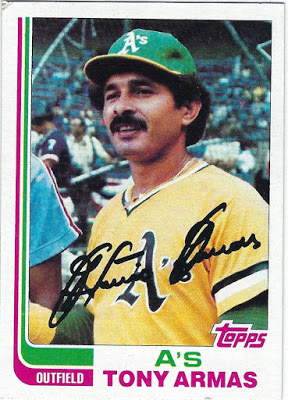
Even though it was represented in both 2013 and 2017 Topps Archives, 1982 Topps or the "Hockey stick set" features one of the most interesting designs I've ever seen. Each card consists of 2 colors in addition to the white borders and photo, a feature fairly rare with other sets that include logos or little color at all. For the A's, those 2 colors are pink and green, a crazy combination that, like nearly every other duo of colors, work very well together.

#1 1983 Topps
Despite their being a decent-sized lineup of above average sets, nothing comes close, in my opinion, to the near masterpiece that is 1983 Topps. The 2 photos on 1 card works better than it does in '84 Topps as well as the '63 set from 2 decades prior. Topps once again featured just 2 colors that, apart from the bottom of the card, appear in slim lines that don't take away from the rest ofthe set.

I like the way 2 colors are designed to connect the top part of the card to the bottom. If this wasn't carefully designed, the cards would seem like 2 different sets instead of 1. To their credit, Topps took a risk and it paid off, big time, with one of the best sets of all-time being the result.